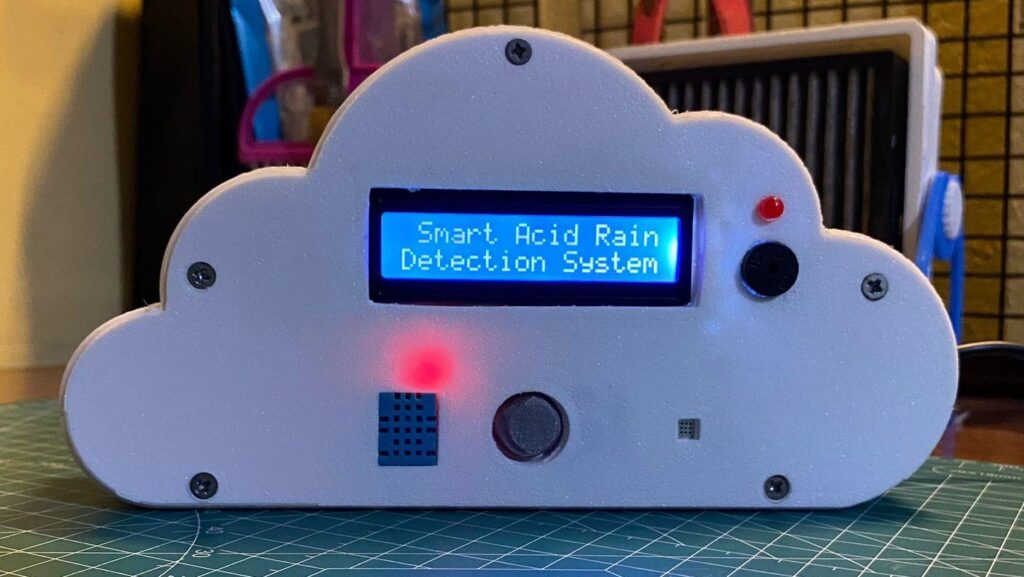
A new device designed by Mohammad Nihal aims to predict acid rain, a phenomenon that poses significant risks to the environment and cultural heritage. Acid rain occurs when sulfur dioxide (SO2) and nitrogen dioxide (NO2) combine with moisture in the atmosphere, resulting in harmful precipitation that can damage ecosystems and historical structures. Nihal’s project offers a creative solution to forecast these occurrences, potentially helping institutions such as universities protect their outdoor assets.
Using an Arduino Nano, the device measures SO2 levels through an MQ-136 gas sensor and NO2 levels with an unspecified MEMS-based sensor. Additionally, it incorporates a DHT11 temperature and humidity sensor to account for moisture content, which is crucial in the formation of acid rain. The Arduino processes data from these sensors and employs a simple predictive algorithm to generate an “Acid Rain Risk Score.” This score is displayed on a 16×2 character LCD, allowing users to monitor acid rain risk in real-time.
Device Limitations and Future Improvements
While the concept is innovative, the device has certain limitations. Its indoor placement means that it may not accurately measure atmospheric SO2 and NO2 levels at the altitudes where rain is formed. Despite these challenges, the potential for refinement exists. Future iterations could enhance the device by integrating more advanced sensors or by placing it outdoors to obtain more accurate readings.
The project exemplifies how technology can be harnessed to address environmental challenges. As researchers and developers continue to improve upon such devices, the hope is that they will contribute to better understanding and forecasting of acid rain, ultimately leading to more effective protective measures for vulnerable ecosystems and cultural landmarks.