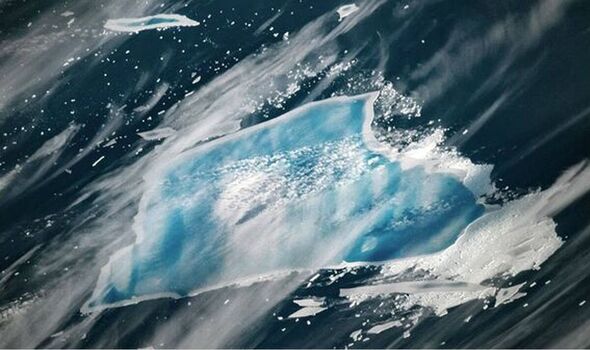
A massive iceberg, known as A-23A, is displaying a striking blue hue as it approaches complete disintegration after nearly four decades. Originally calved from the Filchner Ice Shelf in Antarctica in 1986, A-23A’s transformation signals significant meltwater accumulation as it continues to shrink. At its largest, the iceberg covered an area nearly twice the size of Rhode Island, measuring approximately 4,000 square kilometers.
As of early January 2026, the U.S. National Ice Center reported that A-23A’s size has reduced to 1,182 square kilometers. This drastic decrease followed the loss of several substantial chunks in the summer months of 2025, specifically in July, August, and September, as the iceberg drifted into warmer waters. By December, the iceberg was surrounded by conditions that accelerated its melting process.
Transition of Iceberg Titles
With A-23A’s decline, another iceberg, designated D15a, has now taken the title of the world’s largest. Situated near Australia’s Davis research station, D15a spans roughly 3,000 square kilometers. The NASA Earth Observatory provided insights on A-23A, describing it as “one of the largest and longest-lived bergs ever tracked by scientists.” The observatory noted that the iceberg is now leaking meltwater and is on the verge of disintegrating.
According to Chris Shuman, a retired scientist from the University of Maryland Baltimore County, the indicators are grim for A-23A. He stated, “I certainly don’t expect A-23A to last through the austral summer.” The current trajectory suggests that A-23A may face complete disintegration within days or weeks.
Environmental Implications
As A-23A drifts in the South Atlantic, located between the eastern tip of South America and South Georgia Island, its fate reflects broader environmental concerns related to climate change. The significant melting of icebergs like A-23A is indicative of rising ocean temperatures and the ongoing impacts of climate variability.
Experts emphasize that A-23A’s lengthy journey has been remarkable, but its end appears imminent. The situation serves as a stark reminder of the fragile state of polar ice formations and the implications for global sea levels as these colossal structures continue to melt away.