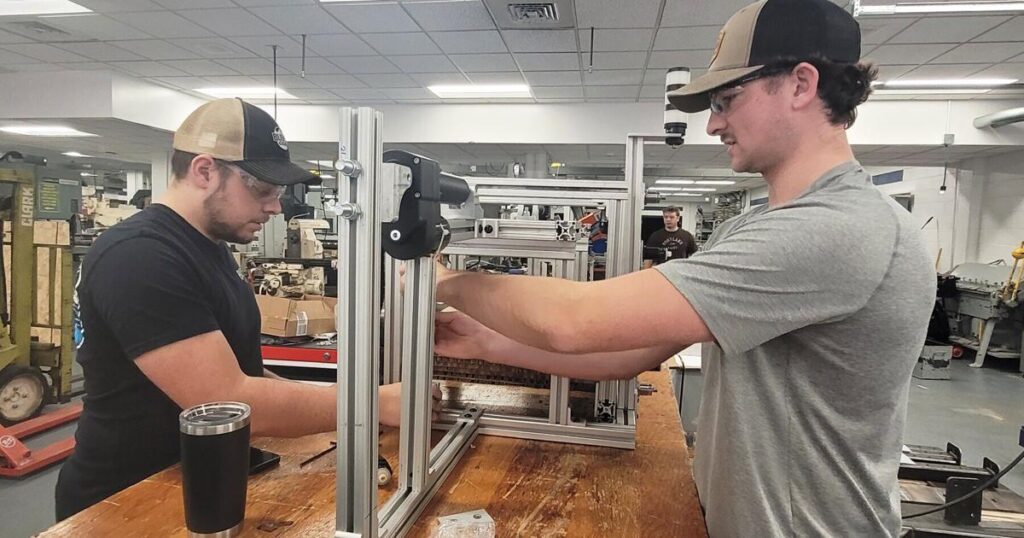
A group of engineering seniors at the University of Wisconsin-Stout has developed a prototype for a nonstandard pallet stacker, sponsored by Ashley Furniture. This initiative aims to enhance operational efficiency in the furniture industry and showcases the innovative capabilities of students.
The project involved students Chase Rodewald, Riley Stiehl, Zachary Morgan, and Luke Mertens, who collaborated to create a functional model of the pallet stacker. Utilizing advanced design software SolidWorks, they were able to transform their conceptual ideas into a tangible prototype, which is designed to improve the handling and stacking of nonstandard pallets.
Enhancing Efficiency in the Furniture Industry
The nonstandard pallet stacker prototype addresses a specific need within the furniture sector. Traditional pallets often do not accommodate the varied shapes and sizes of furniture products, leading to inefficiencies in storage and transportation. The students’ design aims to mitigate these challenges, offering a more adaptable solution for manufacturers.
According to the team, the prototype not only enhances the stacking process but also aims to reduce manual labor requirements and minimize the risk of injury. By automating aspects of pallet management, the design promises to streamline operations, providing a safer workplace for employees while increasing productivity.
The project was part of a broader collaboration between the university and Ashley Furniture, which has a vested interest in developing innovative solutions within the industry. This partnership illustrates the value of academic-industry cooperation, highlighting how educational institutions can contribute to real-world challenges.
A Learning Experience with Real-World Impact
The engineering students not only gained practical experience through this project but also learned about teamwork and problem-solving in a professional context. Chase Rodewald emphasized the importance of working together to meet project goals: “Each member of our team brought different skills and perspectives, which allowed us to create a better product.”
The final prototype has garnered interest from faculty and industry professionals alike. It serves as a testament to the skills and creativity of the students at the University of Wisconsin-Stout, showcasing their ability to tackle complex engineering challenges.
As the project culminates, the team hopes their prototype will inspire further innovations in the field of logistics and manufacturing. By addressing specific industry needs, they aim to contribute to advancements that could benefit not only Ashley Furniture but also the broader furniture manufacturing sector.
This initiative reflects a growing trend in engineering education, where students engage in hands-on projects that align closely with industry requirements. Such experiences equip future engineers with the skills and knowledge necessary to drive innovation and efficiency in their respective fields.