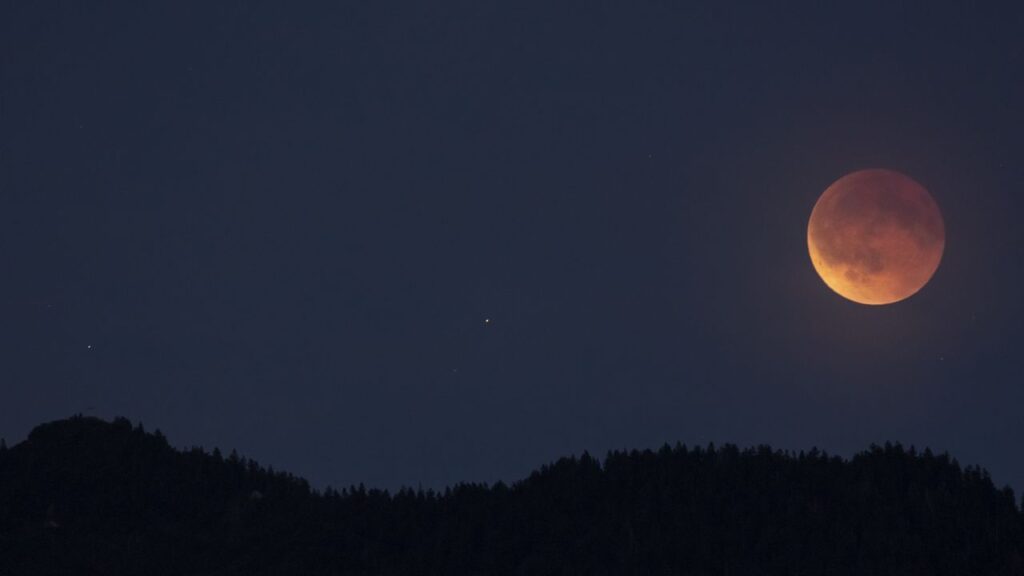
On March 3, 2026, a remarkable total lunar eclipse will grace the night sky, offering spectacular views across various regions, especially in Australia, the Pacific, and the western half of North America. This celestial event, often referred to as a “blood moon,” occurs when the moon passes directly into Earth’s shadow, resulting in a striking reddish hue due to sunlight filtering through the atmosphere.
The best viewing opportunities will arise around midnight in the Pacific, late on March 3 in Australia, and early on March 3 in North America. Clear skies will enhance the experience, allowing observers to witness not just the eclipse but also the twinkling stars and possibly the Milky Way, akin to conditions during a new moon. While dark skies are preferable, they are not essential for viewing the eclipse.
To identify the optimal locations for viewing the eclipse, historical climate data from Eclipsophile.com, a specialist in global cloud cover data, was analyzed. Here are ten prime spots that promise a greater chance of clear skies on the night of this celestial event.
Top Locations for Viewing the Total Lunar Eclipse
1. **Grand Canyon National Park, Arizona, U.S.**
– **Time of Totality:** 04:04-05:02 MST
– **Chance of Clouds:** 63% (historical average)
Known for its dark skies, Grand Canyon National Park has been designated an International Dark Sky Park since 2015. Ideal viewing spots include the Grand Canyon Visitor Center and Mather Point.
2. **Horsetooth Mountain, Colorado, U.S.**
– **Time of Totality:** 04:04-05:02 MST
– **Chance of Clouds:** 60% (historical average)
This stargazing event, hosted by the Northern Colorado Astronomical Society and supported by NASA, will take place from 03:30 to 05:30 MST.
3. **Arkaroola Wilderness Sanctuary, South Australia**
– **Time of Totality:** 21:34-22:32 ACDT
– **Chance of Clouds:** 24% (historical average)
Located in the Flinders Ranges, this sanctuary offers both wildlife and dark skies, making it a premier spot for stargazing.
4. **Warrumbungle Dark Sky Park, Australia**
– **Time of Totality:** 22:04-23:02 AEDT
– **Chance of Clouds:** 45% (historical average)
As Australia’s first Dark Sky Park, Warrumbungle provides an excellent vantage point for the eclipse, particularly for those venturing inland.
5. **Saguaro National Park, Arizona, U.S.**
– **Time of Totality:** 04:04-05:02 MST
– **Chance of Clouds:** 44% (historical average)
Surrounded by stargazing opportunities, Saguaro National Park is notable for its minimal light pollution and is open 24 hours.
6. **Wairarapa Dark Sky Reserve, New Zealand**
– **Time of Totality:** 00:04-01:02 NZDT (March 4)
– **Chance of Clouds:** 64% (historical average)
Regulated outdoor lighting in this reserve enhances visibility for night-sky enthusiasts.
7. **Anza-Borrego Desert State Park, California, U.S.**
– **Time of Totality:** 03:04-04:02 PST
– **Chance of Clouds:** 40% (historical average)
This expansive park is known for its dark skies and is a designated dark sky park since 2018.
8. **Big Island, Hawaii, U.S.**
– **Time of Totality:** 01:04-02:02 HST
– **Chance of Clouds:** 37% (historical average)
The Big Island offers excellent viewing conditions, particularly on the darker coasts and at Maunakea.
9. **Joshua Tree National Park, California, U.S.**
– **Time of Totality:** 03:04-04:02 PST
– **Chance of Clouds:** 43% (historical average)
Despite recent wildfires, this park remains a popular destination for stargazers, especially with advance planning.
10. **Death Valley National Park, Nevada, U.S.**
– **Time of Totality:** 03:04-04:02 PST
– **Chance of Clouds:** 47% (historical average)
With its exceptionally dark skies, Death Valley is a prime location for astrophotographers and casual observers alike.
As the anticipation builds for this striking celestial event, enthusiasts are encouraged to plan their viewing locations in advance. The next total lunar eclipse of this nature will not occur again until New Year’s Eve 2028-2029. Whether you are a seasoned stargazer or a curious observer, this eclipse promises to be a captivating experience.