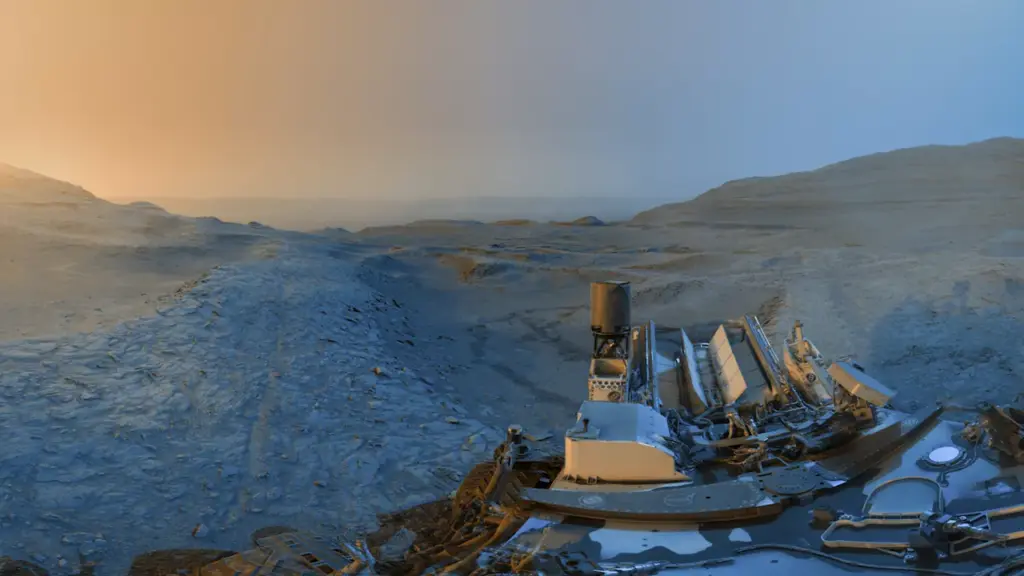
NASA’s Curiosity rover has delivered a breathtaking panoramic view of the Martian landscape from Mount Sharp, showcasing the intricate terrain shaped by ancient water activity. This image, referred to as a “postcard,” combines photographs taken on two separate Martian days in November 2025, specifically Sol 4,722 and Sol 4,723.
Captured at different times—4:15 p.m. and 8:20 a.m. local Mars time—the images highlight how light alters the appearance of the Martian surface. NASA officials noted that, “Adding color to these kinds of merged images helps different details stand out in the landscape.” The resulting panorama features cool blue and warm yellow hues, enhancing the visibility of the rugged geography.
Significance of the Terrain
The landscape depicted in this postcard includes complex formations known as boxwork, characterized by mineral-rich ridges left from ancient groundwater flow. Over billions of years, wind erosion has sculpted the terrain, exposing these hardened mineral veins. Scientists are particularly interested in this area as it holds clues to Mars’ environmental history and the presence of liquid water in the past.
Curiosity has been actively conducting scientific analyses at this location. Recently, the rover utilized its drill to collect samples from a ridge named “Nevado Sajama.” The panoramic view looks northward across the boxwork formations and down the slopes of Mount Sharp, with the crater’s rim visible on the horizon approximately 40 kilometers away. Notably, wheel tracks indicate where Curiosity previously drilled at a site dubbed “Valle de la Luna.”
Continuous Exploration and Findings
For over a decade, Curiosity has been on a mission to uncover the secrets of Mars. The rover focuses on studying sedimentary layers that trace the planet’s transformation from a potentially habitable environment to the arid landscape observed today. Through detailed analysis of rock chemistry, texture, and mineral veins, scientists aim to piece together the planet’s history.
Recent enhancements to Curiosity’s operational capabilities allow it to conduct scientific observations while maintaining communication with orbiters overhead. These improvements have significantly increased the efficiency of the rover, maximizing scientific output from its aging nuclear power source.
As Curiosity continues to provide stunning visuals and valuable data, it underscores the ongoing scientific interest in Mars. More than 13 years after its arrival, the rover remains a vital asset in the exploration of the Red Planet, revealing that it has many more stories left to tell.