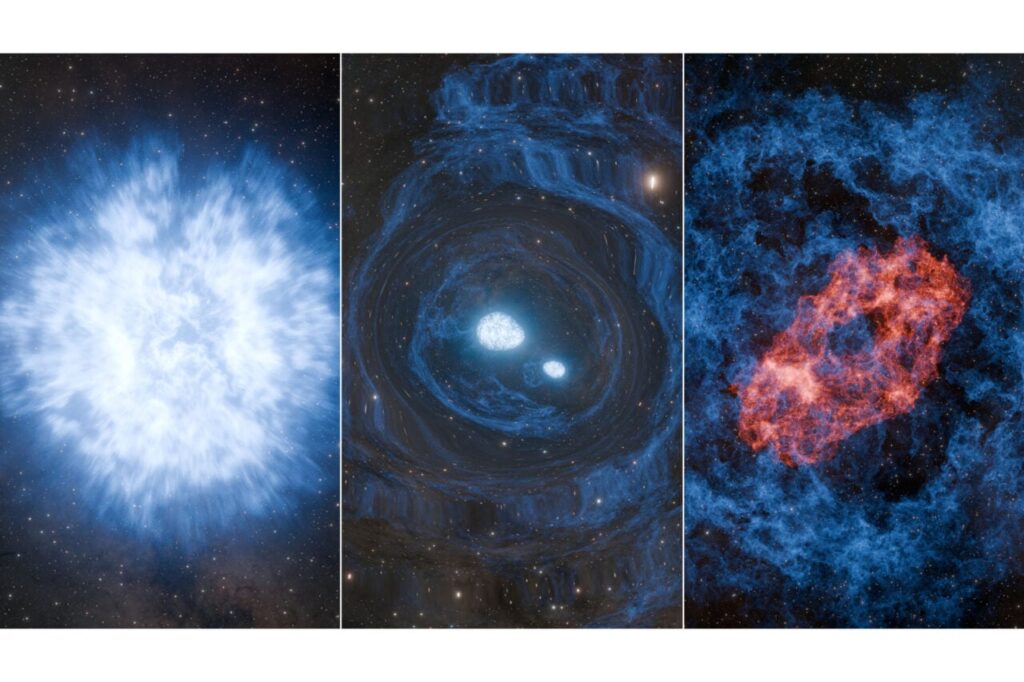
A groundbreaking cosmic event has captured the attention of astronomers: a newly identified phenomenon termed a “superkilonova.” This rare occurrence likely results from the collision of two neutron stars, merging the characteristics of both supernovae and kilonovae. The findings, detailed in a recent paper published in The Astrophysical Journal Letters, were led by researchers from the California Institute of Technology.
The event, designated AT2025ulz, represents the second confirmed kilonova ever detected and is notable for its complex nature. In this instance, a supernova explosion created two neutron stars, which later merged, producing a kilonova. If validated, this discovery could significantly enhance our understanding of stellar evolution and the formation of heavy elements in the universe.
Cosmic Explosions and Element Creation
Supernovae, the powerful explosions marking the end of massive stars, play a crucial role in distributing heavier elements like carbon and iron throughout the universe. Kilonovae, on the other hand, are responsible for even heavier elements such as gold and uranium. These processes are essential for the formation of new stars and planets. Such explosive events also generate gravitational waves, which can be detected on Earth by observatories like LIGO.
Humanity first documented a kilonova in 2017, also with the help of LIGO. In August 2023, the facility alerted astronomers to a new signal that mirrored the earlier detection. Following this, survey cameras identified rapidly fading red lights emanating from the same location, indicating potential heavy element production. Shortly thereafter, the source flared again, this time exhibiting blue light characteristic of supernovae.
Mansi Kasliwal, the study’s lead author and an astrophysicist at Caltech, remarked, “At first, for about three days, the eruption looked just like the first kilonova in 2017. Everybody was intensely trying to observe and analyze it, but then it started to look more like a supernova, and some astronomers lost interest. Not us.”
Unexplained Phenomena and Future Research
Kasliwal emphasized the multitude of unanswered questions surrounding AT2025ulz, suggesting that it did not fit the typical profile of a supernova or the previously observed kilonova. Notably, the gravitational wave data indicated the merger of two neutron stars, one of which was unusually light.
Brian Metzger, co-author of the study and a theoretical physicist at Columbia University, noted the significance of this discovery. “No neutron star had ever been observed before with a mass less than that of the Sun, and it was believed to be theoretically impossible,” he stated. Yet, LIGO’s findings indicated a sub-solar neutron star undergoing a dramatic merger.
The researchers propose that this lightweight neutron star could have resulted from a rapidly spinning massive star that split into two during a supernova. The chaotic nature of this process may have compelled the newly formed neutron stars into a deadly spiral, culminating in a kilonova explosion.
Despite the compelling nature of their findings, the research team acknowledged the need for further investigation. They pointed out that if AT2025ulz is indeed a kilonova, it might not resemble future events and could be mistakenly classified as a supernova. “We do not know with certainty that we found a superkilonova, but the event nevertheless is eye-opening,” Kasliwal concluded.
As scientists continue to explore the implications of this discovery, AT2025ulz stands as a testament to the complexities of the universe and the ongoing quest to unravel its mysteries.