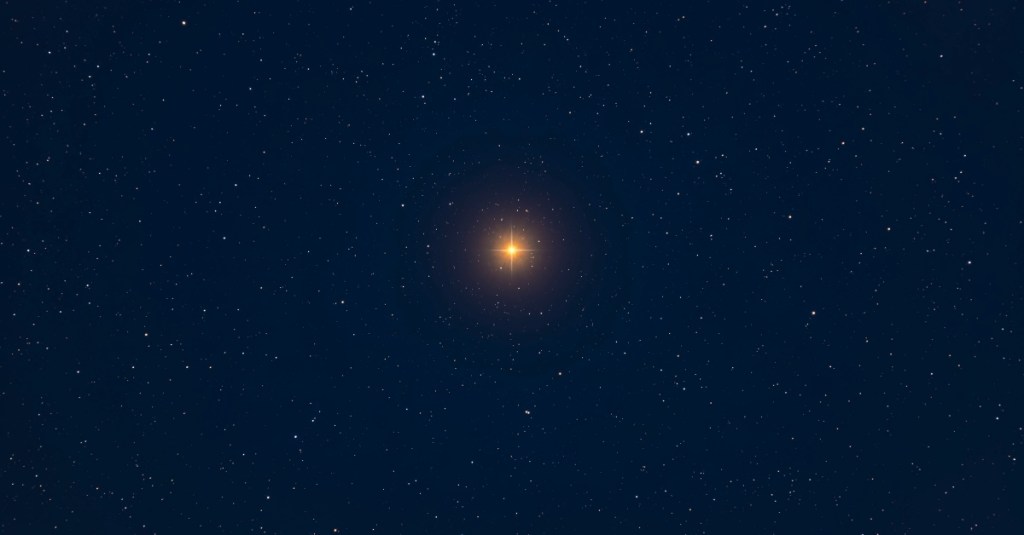
A recent study has confirmed that Betelgeuse, the well-known red supergiant star, possesses a hidden companion star, named Siwarha. This discovery provides an explanation for the previously mysterious long-term brightness fluctuations of Betelgeuse, which pulses every 400 days due to natural processes inherent to aging stars.
For years, astronomers have grappled with a second, slower cycle that repeats approximately every 2,100 days. This cycle did not align with known stellar behaviors and remained an enigma until now. The identification of Siwarha as a companion star that influences Betelgeuse’s brightness marks a significant breakthrough in our understanding of stellar dynamics.
Discovery Process Involving Advanced Observations
The research, which spanned nearly eight years, involved observations using the Hubble Space Telescope and ground-based facilities in Arizona and the Canary Islands. Researchers detected a dense trail of gas moving through Betelgeuse’s atmosphere, created by Siwarha as it orbits the red giant. This gas trail acts like a wake, altering the ultraviolet light emitted by Betelgeuse, particularly affecting emissions from ionized iron.
When Siwarha passes in front of Betelgeuse, the star’s light intensity experiences a sharp increase. As Siwarha moves onward, the gas trail absorbs some of the radiation, leading to a decrease in brightness. This pattern consistently aligns with the previously observed 2,109-day cycle, confirming the theory of a companion star’s influence.
Andrea K. Dupree, the lead author of the study, described the phenomenon in a statement from NASA. She likened the movement of Siwarha to a boat navigating through water, creating a “ripple effect” in Betelgeuse’s atmosphere. “For the first time, we’re seeing direct signs of this wake, or trail of gas, confirming that Betelgeuse really does have a hidden companion shaping its appearance and behavior,” she said.
Future Observations and Implications
As Siwarha has now moved behind Betelgeuse, it will not reappear until August 2027. In the meantime, astronomers will continue to monitor the ripples in Betelgeuse’s atmosphere, using the insights gained from this discovery to enhance their understanding of stellar behavior.
This finding not only clarifies the long-standing mystery surrounding Betelgeuse’s brightness fluctuations but also highlights the intricate relationships that can exist between stars. As research progresses, it may offer new insights into the life cycles of massive stars and their interactions in the cosmos.
The confirmation of Siwarha as Betelgeuse’s companion enriches our understanding of the universe, demonstrating how much remains to be discovered about the celestial bodies that populate it.