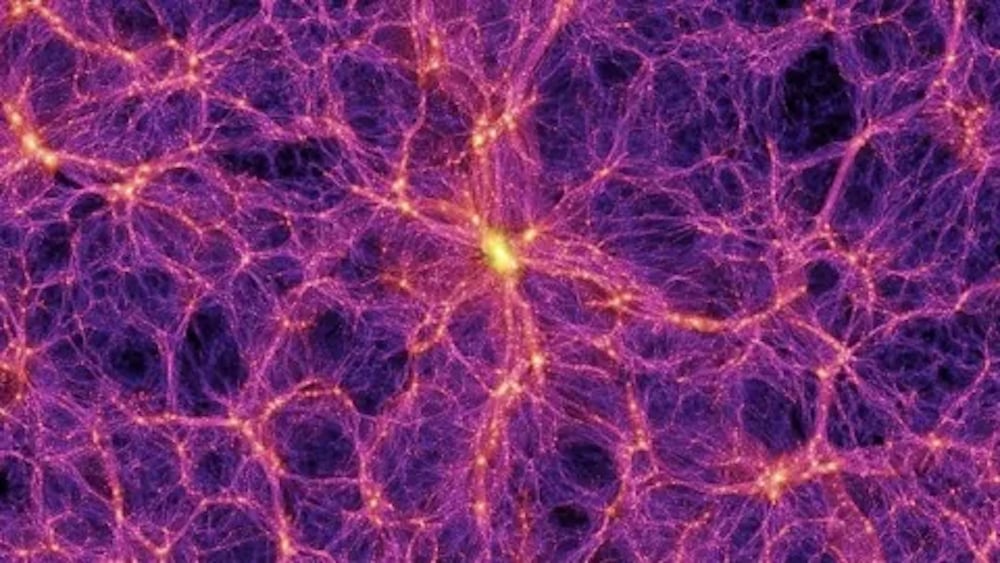
Astronomers have made a groundbreaking discovery by identifying a vast cosmic filament rotating in space. This structure, embedded in the universe’s largest known formations, measures approximately 50 million light years long and contains over 280 galaxies. The findings were led by a team from the University of Oxford and offer new insights into galactic evolution.
The filament showcases a remarkably thin alignment of 14 hydrogen-rich galaxies, spanning just 5.5 million light years in length but only 117,000 light years wide. The alignment is not random; many of the galaxies are rotating in the same direction as the filament itself. Detailed analysis indicates that the entire structure is also in motion, rotating as a cohesive unit.
To determine the rotation dynamics, researchers observed the motion of galaxies flanking the filament’s central spine. They found that galaxies on opposite sides move in contrary directions, a clear indicator of rotation. The calculated rotation velocity is approximately 110 kilometres per second, with the filament’s central core estimated to have a radius of about 163,000 light years.
This dual motion, where individual galaxies spin while the entire structure rotates, provides valuable insights into the mechanisms by which galaxies acquire angular momentum. Current scientific theories suggest that galaxies gain their spin through interactions with nearby structures. However, this discovery implies that large-scale rotation may play a more significant role in influencing galaxy spins than previously understood.
Insights into Cosmic Evolution
The filament appears to be in an early stage of evolution, characterized by a significant abundance of gas-rich galaxies and low internal motion, a state referred to as “dynamically cold.” This suggests that the structure has remained relatively undisturbed since its formation. These hydrogen-rich galaxies are crucial for understanding the flow of gas along cosmic filaments.
Atomic hydrogen serves as the foundational material for star formation and is sensitive to disturbances, making it an effective tracer for observing how material is funneled through these cosmic pathways into galaxies.
The discovery resulted from a collaboration that combined data from South Africa’s MeerKAT Radio Telescope with optical observations from various surveys mapping the Cosmic Web. This multi-wavelength approach effectively revealed both the coherent spin alignment of the galaxies and the collective rotation of the filament, showcasing the benefits of using different telescopes to uncover phenomena that cannot be observed through a single instrument.
The findings highlight the intricate processes that govern cosmic structures and their evolution, offering astronomers a new lens through which to explore the universe’s vast complexities. This research not only enhances our understanding of galaxy formation but also emphasizes the importance of collaborative scientific efforts in advancing knowledge in astrophysics.