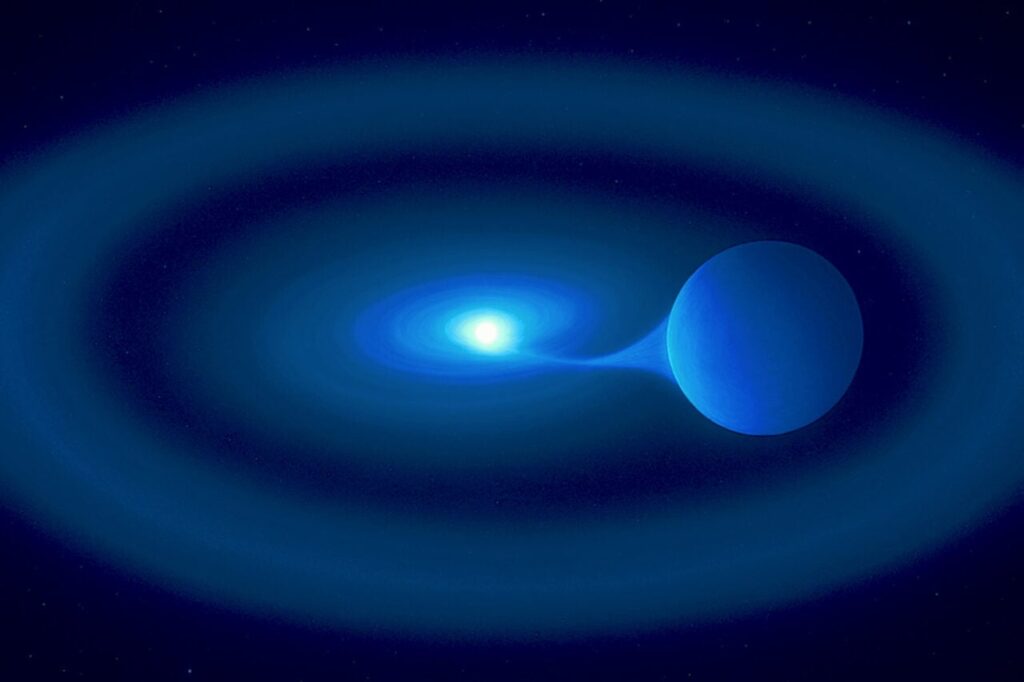
A remarkable astronomical phenomenon is unfolding in the binary star system known as V Sagittae, located approximately 10,000 light-years from Earth. A recent study published in August 2023 in the journal Monthly Notices of the Royal Astronomical Society reveals that one star, a white dwarf, is consuming its companion at an extraordinary rate. This process is expected to culminate in a supernova explosion bright enough to be seen from Earth during the day.
Researchers have long been puzzled by the intense luminosity of V Sagittae, which was first identified in 1902. The current study, led by a team from various universities, confirms that the white dwarf is “scarfing down” material from its larger star counterpart. The consumption of this matter generates immense energy, triggering thermonuclear reactions on the surface of the white dwarf.
Phil Charles, a co-author of the study from the University of Southampton, explained the significance of the findings. “The extreme brightness is due to the white dwarf sucking the life out of its companion star, using the accreted matter to turn it into a blazing inferno,” he stated. This extreme interaction between the two stars leads to a unique and dynamic system, where they orbit each other every 12.3 hours.
Impact of the Discovery on Stellar Research
The research team utilized the European Southern Observatory’s Very Large Telescope in Chile to observe the binary system. In addition to the stellar interaction, they also discovered a substantial ring of gas surrounding the stars. This ring consists of debris generated from the white dwarf’s intense energy output. According to Pasi Hakala, a co-lead author and researcher at the University of Turku, this finding could reshape existing knowledge about stellar birth and death cycles.
“The white dwarf cannot consume all the mass being transferred from its hot star twin, creating this bright cosmic ring,” Hakala explained. The dynamics of this system indicate a chaotic state, likely a precursor to its eventual destructive end.
Future Implications for Observers on Earth
As the white dwarf continues to accumulate matter, an imminent nova outburst is anticipated. According to Pablo Rodríguez-Gil, the other co-lead author from the Instituto de Astrofísica de Canarias, this explosion will make V Sagittae visible without the aid of telescopes.
“The nova will be a precursor to the eventual collision of the two stars,” Rodríguez-Gil noted. When the stars ultimately collide, the resulting supernova will be so bright that it will be observable from Earth even in daylight.
The findings from the study not only highlight the dramatic fate of V Sagittae but also open new avenues for understanding similar celestial phenomena. Scientists are eager to continue monitoring this extraordinary binary system as it approaches its explosive conclusion.