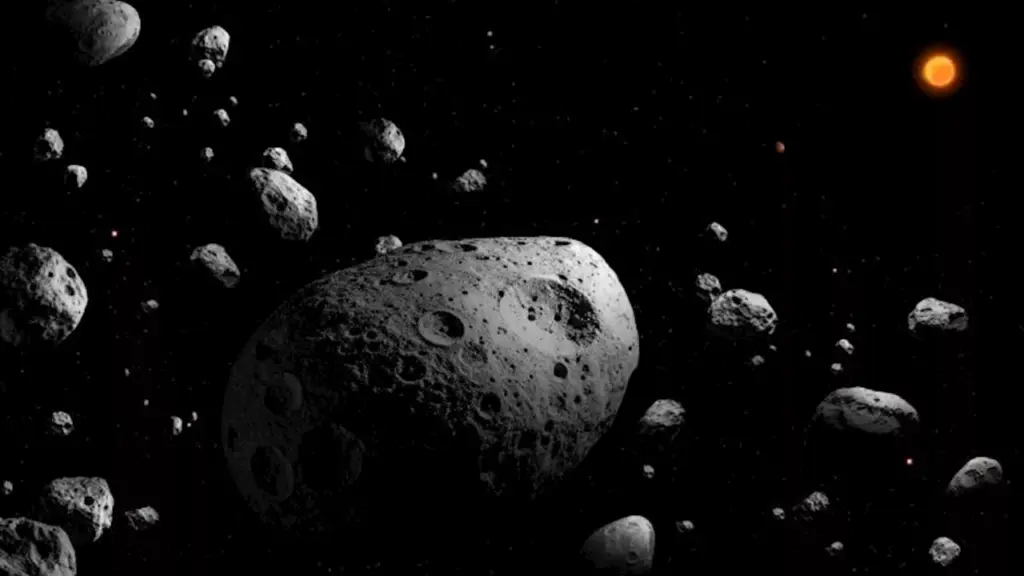
The Vera C. Rubin Observatory has identified a remarkable new asteroid named MM45, which spins at an unprecedented rate for its size. This discovery has captivated astronomers, as MM45 is now recognized as the fastest-known asteroid larger than 500 meters, completing a full rotation in just 1.88 minutes. This finding is part of a larger survey that detected nearly 2,000 asteroids in 2025, with 19 classified as either super-fast or ultra-fast rotators.
Significance of the Discovery
The study of these asteroids, conducted by the National Science Foundation’s NOIRLab and the SLAC National Accelerator Laboratory, examined 76 asteroids, including 16 that rotate rapidly. Among these, three ultra-fast rotators complete a spin in less than five minutes, with MM45 standing out due to its extreme speed. Most asteroids are described as “rubble piles,” composed of smaller rocks held together by gravity, making MM45’s rapid rotation particularly noteworthy.
According to Sarah Greenstreet, a study author at NOIRLab, the internal strength of MM45 is likely exceptional. “Clearly, this asteroid must be made of material that has very high strength in order to keep it in one piece as it spins so rapidly,” she noted. “We calculate that it would need a cohesive strength similar to that of solid rock.” This is surprising, as most asteroids are believed to consist of many small fragments coalesced under gravitational forces throughout the history of the Solar System.
Rapid Discoveries and Future Implications
Another newly discovered asteroid closely follows MM45, rotating approximately every 1.9 minutes. The speed and efficiency of these discoveries are notable, as they were made over just ten hours of observation rather than months. The Rubin Observatory’s Legacy Survey of Space and Time aims to create the most extensive astronomical survey of the Southern Hemisphere night sky over a ten-year period.
“We have known for years that Rubin would act as a discovery machine for the Universe, and we are already seeing the unique power of combining the LSST Camera with Rubin’s incredible speed,” said Aaron Roodman, Deputy Head of LSST and professor of particle physics and astrophysics at SLAC. “The ability to find thousands of new asteroids in such a short period of time, and learn so much about them, is a window into what will be uncovered during the ten-year survey.”
The Vera C. Rubin Observatory, dedicated to the late astronomer Vera Rubin—who provided groundbreaking evidence for dark matter—will begin full operations in 2026. It is equipped with the largest digital camera ever built, enhancing its capacity to explore the cosmos and contribute to our understanding of asteroids and other celestial bodies.
As astronomers continue to analyze the data produced by the Rubin Observatory, they remain eager to uncover more about the characteristics and compositions of these fast-rotating asteroids, which could yield significant insights into the formation and evolution of our Solar System.