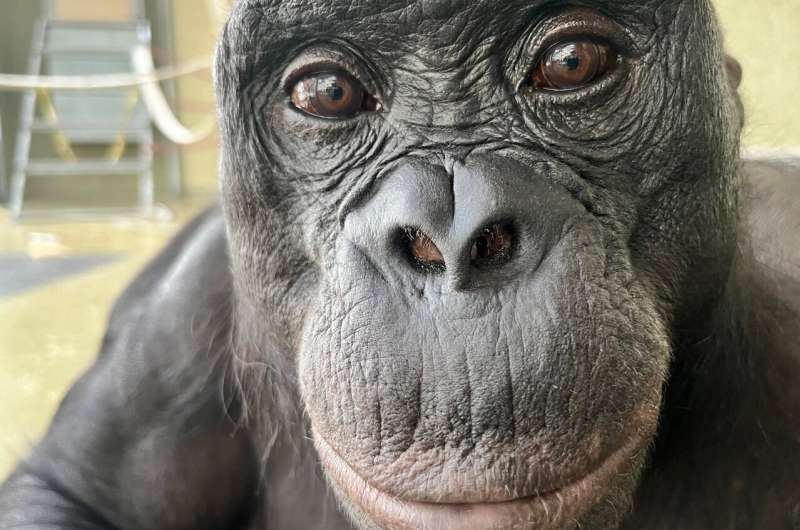
Researchers at Johns Hopkins University have made a significant discovery suggesting that apes possess the ability to engage in imaginative play, a trait previously thought to be unique to humans. In a series of innovative experiments, a bonobo named Kanzi demonstrated the capacity to interact with imaginary objects, such as juice and grapes, marking a pivotal shift in understanding animal cognition.
Through three meticulously designed experiments, the research team observed Kanzi participating in tea party-like scenarios that challenged existing assumptions about animal intelligence. The results indicate that the ability to comprehend pretend objects may extend back to our common ancestors, which lived between 6 to 9 million years ago.
Imaginative Play in Apes
In the first experiment, Kanzi faced an experimenter who pretended to pour juice from an empty pitcher into two cups. When asked to identify the location of the “juice,” Kanzi accurately pointed to the correct cup, even when the position of the cup changed. This suggests that he could grasp the concept of an imaginary object, even in the absence of tangible evidence.
The second experiment included a cup of real juice alongside the imaginary one. When prompted, Kanzi consistently chose the real juice, indicating an understanding of the difference between reality and pretense. A third experiment involved pretend grapes, where Kanzi again identified the location of the imaginary object after the experimenter mimicked sampling from an empty container.
According to Christopher Krupenye, an assistant professor in the Department of Psychological and Brain Sciences, these findings challenge the long-held belief that imagination is solely a human trait. “It really is transformative to consider that their mental lives go beyond the here and now,” he stated. This research opens up new conversations about how we define what makes humans unique.
Implications for Understanding Animal Cognition
The results, published on February 5, 2026, in the journal Science, could have profound implications for how we view the mental lives of other species. Amalia Bastos, a co-author of the study, expressed excitement over the findings, stating, “It’s extremely striking that the data suggest that apes can conceive of things that are not there.” This challenges assumptions about animal behavior, urging a reconsideration of what constitutes a rich mental life.
Historically, examples of animal play have been anecdotal, with observations of young chimpanzees carrying sticks as if they were infants or engaging with imaginary objects in captivity. This research provides a controlled framework to explore these behaviors scientifically, inviting further studies on whether other species might exhibit similar imaginative capacities.
Krupenye emphasized the importance of these findings, suggesting they should inspire a reevaluation of our relationship with animals. “We should be compelled to care for these creatures with rich and beautiful minds and ensure they continue to exist,” he remarked.
As researchers continue to explore the facets of imagination in apes, they hope to uncover whether other animals can engage in pretend play. This groundbreaking research not only expands our understanding of animal cognition but also invites us to reflect on the complexity of mental processes in non-human species.
The study underscores a growing recognition that the line separating human and animal cognition may not be as distinct as once thought, prompting a broader inquiry into the capabilities of our fellow creatures.