New research has uncovered that rock art along the Pecos River in West Texas dates back approximately 6,000 years and reveals intricate metaphysical concepts that have shaped the belief systems of various Mesoamerican cultures. This study, conducted partly at Texas State University, involved a collaboration among experts including Karen Steelman, Ph.D., of the Shumla Archaeological Research and Education Center, Carolyn Boyd, Ph.D., Shumla Endowed Research Professor at Texas State University, and Phil Dering, Ph.D., who is associated with the university’s Department of Anthropology.
The findings, titled “Mapping the chronology of an ancient cosmovision: 4000 years of continuity in Pecos River style mural painting and symbolism,” were published in the journal Science Advances. Boyd emphasized the significance of the research, stating, “We have securely dated one of the most distinctive rock art traditions in the world — the Pecos River style murals of Southwest Texas.”
The research team conducted 57 radiocarbon dates across 12 sites, revealing that Indigenous communities began painting these vibrant murals almost 6,000 years ago. The study asserts that the creation of these polychromatic artworks did not cease after their initial painting. Rather, the same stylistic elements, symbol systems, and painting techniques were employed continuously for over 4,000 years.
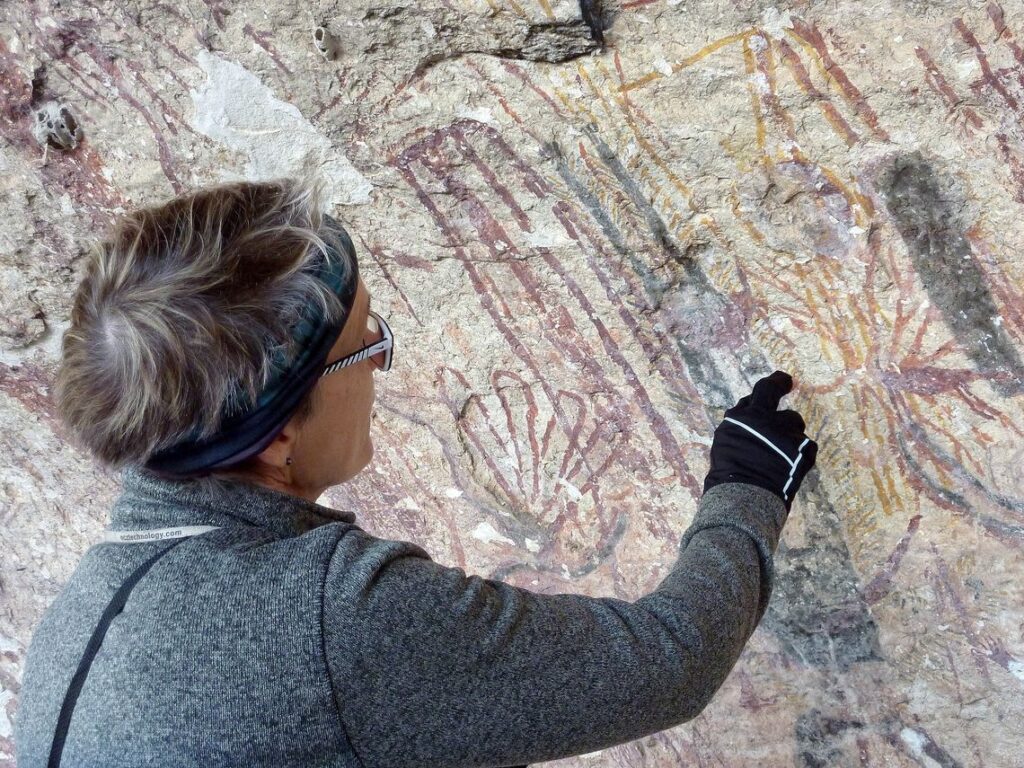
In the arid landscape of Southwest Texas and northern Mexico, forager societies created expansive murals known as pictographs, painting scenes that feature human-like, animal-like, and geometric figures. These compositions can extend up to 100 feet long and 20 feet tall, and the dry climate has ensured their remarkable preservation over millennia.
Previous beliefs among archaeologists suggested that these murals were built up over centuries as a random collection of images. However, the new radiocarbon dating has reshaped this perspective. Boyd noted, “Another huge shocker is that the dates within many of the murals clustered so closely as to be statistically indistinguishable, suggesting that they were produced during a single painting event as a visual narrative.” This revelation challenges the long-standing notion that these works accumulated over time.
The research employed advanced techniques, yielding 57 direct radiocarbon dates and 25 indirect oxalate dates for the pictographs. Bayesian modeling indicates that the Pecos River style began between 5,760 and 5,385 years ago and likely concluded between 1,370 and 1,035 years ago. Comprehensive stratigraphic and iconographic analyses demonstrated that eight of the murals were purposefully created according to a defined set of rules and an established symbolic vocabulary.
The researchers concluded that the Pecos River style paintings, interwoven within a culturally significant landscape, communicated complex metaphysical ideas that subsequently informed the beliefs and symbolic expressions of Mesoamerican agricultural societies. Boyd elaborated on the methodology, stating, “Using a digital microscope to retrace the steps followed by the original artists, we discovered that the painters adhered to a rule-bound color application order.” This meticulous attention to detail resulted in sophisticated compositions, indicative of an advanced understanding of art-making that persisted across generations.
Perhaps most importantly, Boyd highlighted how contemporary Indigenous communities in the U.S. and Mexico are able to relate these ancient stories to their own cosmologies. She remarked, “Think about it, the canyons of Southwest Texas house a vast and ancient library of painted texts documenting 175 generations of sacred stories and Indigenous knowledge.”
As both an artist and an archaeologist, Boyd described the discovery as breathtaking, emphasizing the enduring legacy of these artworks that showcase a pan-New World belief system dating back at least 6,000 years. The research not only enhances our understanding of the Pecos River rock art but also reflects the profound connections between ancient practices and contemporary Indigenous identities.