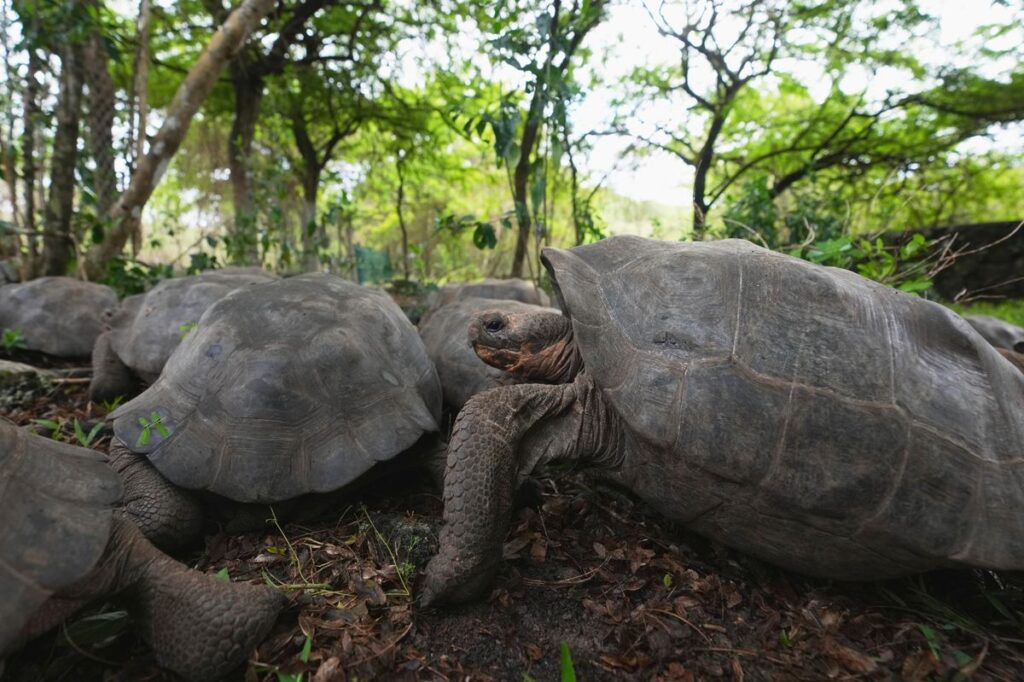
The reintroduction of 158 juvenile giant tortoises to Floreana Island in Ecuador’s Galápagos archipelago marks a significant step in a large-scale conservation initiative aimed at restoring the island’s ecosystem. This event occurred on November 3, 2023, nearly 150 years after the last giant tortoises were removed from the area.
The tortoises, aged between 8 and 13 years, have begun to explore their new habitat, coinciding with the arrival of the first winter rains. Fredy Villalba, director of the Galápagos National Park breeding center on Santa Cruz Island, emphasized the importance of the timing. “They are large enough to be released and can defend themselves against introduced animals such as rats and cats,” he stated. The selection process for these tortoises involved choosing the best specimens with the strongest genetic lineage, specifically for the Floreana environment.
These 158 tortoises are part of a broader plan to reintroduce a total of 700 individuals to Floreana over time. According to Christian Sevilla, director of ecosystems for the Galápagos National Park, the tortoises carry between 40% and 80% of the genetic makeup of the Chelonoidis niger, a species that has been extinct for the past 150 years. The lineage of these hybrids can be traced back to Wolf Volcano on Isabela Island, a fact that continues to intrigue scientists.
Restoring a Lost Ecosystem
Historically, Floreana Island was home to approximately 20,000 giant tortoises. However, due to whaling, catastrophic fires, and extensive human exploitation, their population was decimated. Biologist Washington Tapia, director of Biodiversa-Consultores, highlighted that reintroducing a species with a significant genetic component of the original population is crucial for the island’s ecological restoration. “This process is about more than just numbers; it’s about restoring a lost lineage,” Tapia explained.
The tortoises will inhabit an area shared with a small community of nearly 200 residents and diverse wildlife, including flamingos, iguanas, penguins, sea gulls, and hawks. However, they will also face challenges from non-native species introduced by human activity, such as blackberry, guava, rats, cats, pigs, and donkeys. These invasive species pose potential threats to the survival of the newly released tortoises.
Floreana Island spans approximately 67 square miles and serves as the southernmost point of the Galápagos archipelago, located about 621 miles from the Ecuadorian mainland. This volcanic island remains a vital ecological site, recognized as a Natural World Heritage Site by the U.N. in 1978, due to its unique array of terrestrial and marine species not found elsewhere.
The reintroduction of these giant tortoises is a hopeful sign for conservation efforts in the Galápagos Islands, which continue to face environmental pressures. By carefully managing the tortoise population and addressing the challenges posed by invasive species, conservationists aim to breathe new life into Floreana’s once-thriving ecosystems.