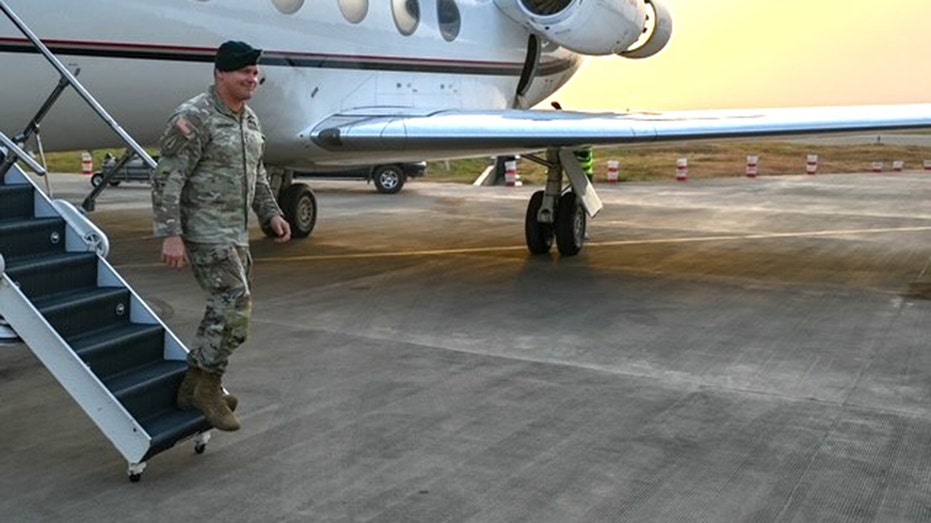
U.S. Army Lt. Gen. John W. Brennan traveled to Nigeria this week to engage in security discussions, following a series of U.S. airstrikes aimed at Islamist militants. These strikes, ordered under the administration of President Donald Trump, were intended to combat the ongoing violence against Christians in Nigeria, which has been designated a Country of Particular Concern due to its alarming rates of religious persecution.
During his visit to Abuja, Lt. Gen. Brennan, who is the deputy commander of U.S. Africa Command, emphasized the U.S. commitment to assisting Nigerian forces in their fight against terrorism. He stated that the U.S. is providing essential intelligence support and airborne intelligence, surveillance, and reconnaissance (ISR) capabilities to enhance the effectiveness of Nigerian operations against groups such as Boko Haram and the Islamic State West Africa Province (ISWAP).
According to a report by the persecution watchdog Open Doors World Watch List, Nigeria accounts for three out of every four Christians killed for their faith globally. The situation is dire, with one Christian reportedly killed every two and a half hours due to ongoing violence. Lt. Gen. Brennan noted that the recent U.S. strikes had a significant impact, causing many terrorists to flee, which inadvertently allowed Nigerian forces to apprehend some militants.
In a statement to Fox News Digital, Brennan highlighted the necessity of empowering Nigerian forces to resolve their own security challenges. He remarked, “We’re all about enabling Nigerians to solve Nigerian problems,” underscoring the mutual interest in stabilizing the region. The general further elaborated that the U.S. aims to help Nigeria maintain its role as a security anchor for West Africa.
Military analyst Illia Djadi, from Open Doors, confirmed that the U.S. airstrikes have disrupted the operational capacity of terrorist groups in Nigeria. He stated, “They are on the run now… they realize they can be hit again,” suggesting that the recent military actions have instilled fear among the militants. Djadi also pointed out that the implications of these strikes extend beyond Nigeria’s borders, with neighboring countries like Niger and Mali closely observing the developments.
On a broader scale, U.S. and Nigerian officials convened this week to strategize on counterterrorism efforts following President Trump’s designation of Nigeria as a country of Particular Concern. During this meeting, Allison Hooker, Under Secretary of State for Political Affairs, emphasized the need for collaboration to deter violence, investigate attacks, and hold perpetrators accountable.
Despite the progress, Nigeria continues to grapple with severe security issues. Just days before the U.S. delegation arrived, over 160 worshippers were reportedly kidnapped from churches in northern Kaduna State, and at least 51 Christians were killed in an attack in Plateau State.
In an interview earlier this month, President Trump indicated that more military action might be taken if violence against Christians persists. A U.S. defense official reiterated this sentiment, noting that Nigerian partners are requesting additional support to combat the ongoing threats.
While there are some U.S. troops on the ground in Nigeria, the numbers remain limited. Lt. Gen. Brennan explained that their role is primarily focused on assessment and support rather than direct engagement. He acknowledged that military equipment is being supplied, but clarified that it consists of previously purchased items aimed at enhancing the operational capability of Nigerian forces.
Rabiu Ibrahim, Nigeria’s special assistant to the minister of information and national orientation, expressed the nation’s stance on terrorism as a global threat that necessitates a coordinated response. He remarked that U.S. military actions are viewed as tactical components in a larger strategy to combat terrorism in the region.
The cooperation between the U.S. and Nigeria is described as robust and multifaceted, focusing on capacity building and training. Ibrahim emphasized that Nigerian units have received advanced training that enhances their effectiveness in counterterrorism operations.
As the situation evolves, both U.S. and Nigerian leaders remain committed to tackling the challenges posed by militant groups, hoping to bring stability to Nigeria and safeguard vulnerable communities facing relentless threats.