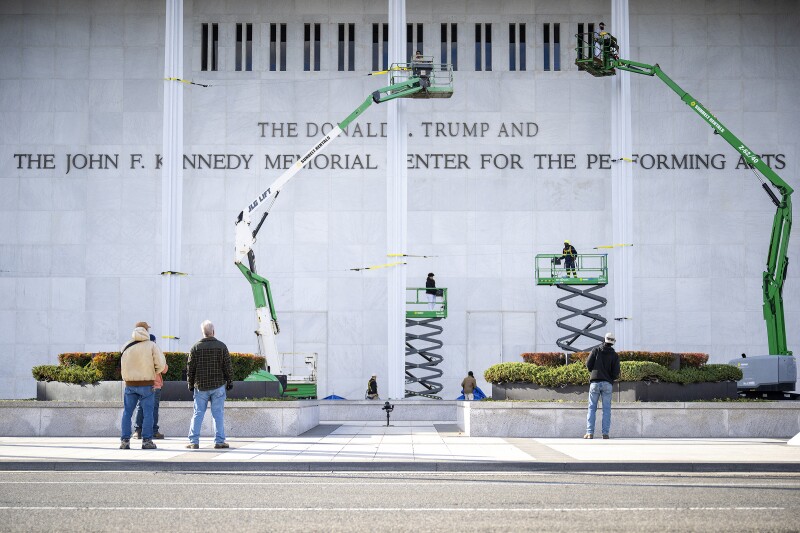
President Donald Trump has drawn significant criticism for the recent renaming of the John F. Kennedy Center for the Performing Arts to include his name, now officially titled “The Donald J. Trump and the John F. Kennedy Center for the Performing Arts.” This change, implemented by a board appointed by Trump himself, has raised questions about legal compliance and appropriateness, prompting a lawsuit from Rep. Joyce Beatty, who seeks to restore the center’s original name.
The controversy began when Trump’s newly appointed board, which includes his allies such as Susie Wiles and Brian Ballard, voted unanimously to approve the name change. Critics argue that the process was heavily orchestrated, with dissenting voices allegedly silenced. Beatty, who participated in the meeting as an ex officio member, reported that her attempts to voice opposition were thwarted when her microphone was muted. The congresswoman is now pursuing legal action to revert the name to its original designation, as mandated by federal law.
Legal and Cultural Implications
The renaming of the Kennedy Center poses potential legal violations. According to legislation that established the center as a memorial to President John F. Kennedy, “no additional memorials or plaques in the nature of memorials shall be designated or installed in the public areas” of the facility. The exceptions for major donors do not appear to apply to Trump’s name, raising concerns about the legality of this action.
Critics have voiced their disapproval not only of the name change but also of the broader implications for the arts and culture in the United States. Maria Shriver, niece of John F. Kennedy, highlighted the contrast between her uncle’s legacy and Trump’s actions. She noted, “He brought the arts into the White House and he and my Aunt Jackie amplified the arts, celebrated the arts, stood up for the arts and artists.”
Since the board’s restructuring, the Kennedy Center has experienced significant fallout. Performances, including a scheduled showing of “Hamilton,” have been canceled, and ticket sales have reportedly declined sharply. The immediate impact of this turmoil reflects a wider concern regarding the celebration of the arts under Trump’s leadership.
A Pattern of Personalization in Governance
This incident is not an isolated event but part of a broader pattern of behavior exhibited by Trump throughout his presidency. His penchant for personal branding has manifested in various initiatives, including the naming of a new pharmaceutical plan as “Trump Rx” and the establishment of commemorative coins featuring his likeness. This trend raises questions about the implications for public trust and governance.
Further, Trump’s administration has been characterized by controversial actions that some observers describe as self-serving. He has faced scrutiny for decisions affecting military personnel and funding, such as the promise of bonuses without Congressional approval and potential misuse of military housing appropriations. Critics argue that this approach undermines the principles of public service, transforming the presidency into a vehicle for personal ambition rather than a position of public trust.
As discussions surrounding the Kennedy Center continue, the implications of Trump’s actions extend beyond the arts. They touch on the fundamental principles of governance, accountability, and respect for the legacies of past leaders. The ongoing legal challenge led by Beatty may ultimately determine the future of the center and the precedent it sets for similar actions in the future.
The situation remains fluid as stakeholders from various sectors weigh in, balancing the preservation of cultural heritage with the realities of contemporary political dynamics. As the nation watches, it is clear that the renaming of the Kennedy Center has sparked a debate that goes far beyond a single institution, touching on the essence of American values and identity.