On March 15, 2024, President Donald Trump announced that the United States will take control of Venezuela following the capture of President Nicolás Maduro. This significant operation has shifted global attention from military tactics to the implications of Trump’s statement regarding the U.S. role in Venezuela’s governance.
Defining the U.S. Role in Venezuela
The immediate question arising from Trump’s declaration is what he means by “run.” Trump emphasized the need for a “safe, proper, and judicious transition” in Venezuela, indicating a temporary U.S. oversight until a stable government can be established. He stated, “We’re going to run the country until such time as we can do a safe, proper, and judicious transition.”
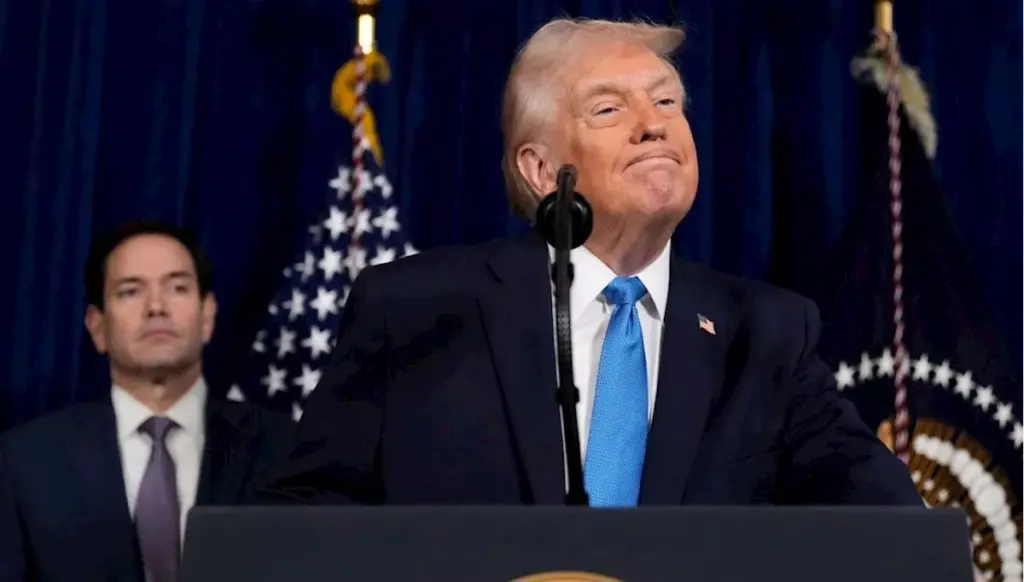
During a press conference, Trump was pressed on the specifics of this transition. A reporter inquired about the mechanisms that would be in place for U.S. oversight. Trump responded affirmatively, stating, “Yes, it’s all being done right now. We’re designating people.” He noted that those designated would include key officials standing behind him, including Secretary of State Marco Rubio, War Secretary Pete Hegseth, and CIA Director John Ratcliffe.
Trump’s comments suggest an active U.S. involvement in Venezuela, raising concerns about whether this entails deploying troops on the ground. He acknowledged the presence of American forces, saying, “We had boots on the ground last night at a very high level.” This statement underscores the seriousness of the U.S. commitment to stabilizing the situation.
The U.S. Strategy Moving Forward
Rubio elaborated on the administration’s position, clarifying that the U.S. does not intend to directly govern Venezuela through appointed officials or legislative changes. Instead, the focus is on guiding Venezuelan leadership away from corruption in the oil sector and narcotics trafficking. “We’re focused on no more drug trafficking, no more Iran/Hezbollah presence there,” Rubio stated.
Central to the U.S. strategy is Venezuela’s oil industry, which remains a crucial element of the nation’s economy. Rubio emphasized that while the U.S. does not require Venezuelan oil, it cannot allow adversaries like China, Russia, or Iran to control it. He remarked, “We’re not going to allow the Western Hemisphere to be a base of operations for adversaries, competitors, and rivals of the United States.”
This strategic approach includes a blockade on Venezuelan oil transactions, which Rubio claims is essential for limiting the country’s economic progress until U.S. interests and the welfare of the Venezuelan people are aligned. “Their economy will not be able to move forward until the conditions that are in the national interest of the United States are met,” he said.
The administration’s early statements raise questions about the long-term U.S. commitment to Venezuela. The challenge for Trump is to stabilize the situation swiftly to avoid accusations of entanglement in an unending conflict, reminiscent of past military interventions. Success in this operation could bolster Trump’s standing ahead of the midterm elections, while failure could invite significant criticism.
As the international community watches closely, the coming days will reveal the nature and extent of U.S. involvement in Venezuela’s governance and the potential consequences for the region. The administration’s ability to navigate this complex situation will be crucial in determining not just the future of Venezuela, but also the credibility of U.S. foreign policy.