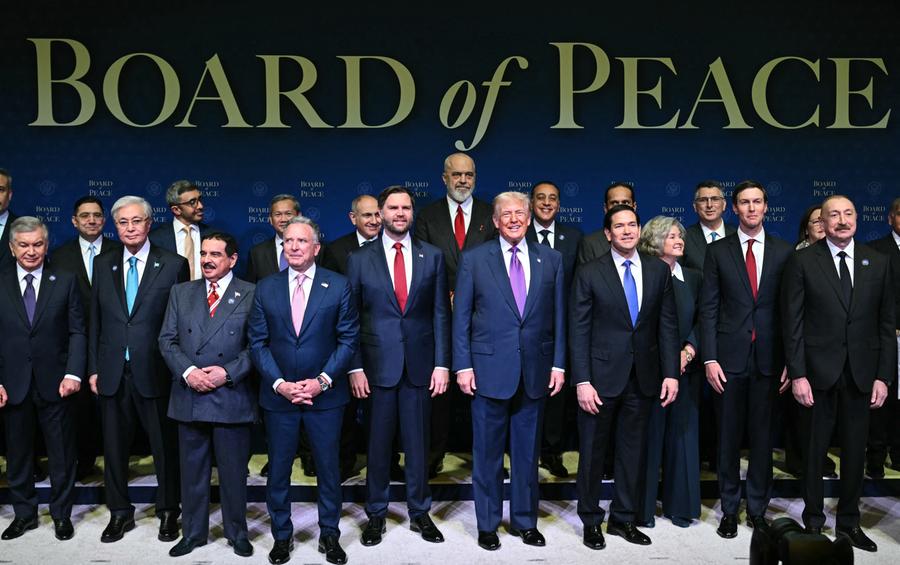
During the inaugural meeting of the US-led Board of Peace on March 15, 2024, President Donald Trump announced a commitment of $17 billion to support the reconstruction of Gaza. Trump’s pledge includes $10 billion from the United States, with the remaining $7 billion sourced from several key Arab nations. The funds are intended to rebuild Gaza in the aftermath of the conflict, contingent upon the disarmament of Hamas.
In addition to the financial commitment, Trump revealed that five countries have agreed to contribute troops to the new International Stabilisation Force (ISF). The participating nations are Indonesia, Morocco, Albania, Kosovo, and Kazakhstan. Trump emphasized that the IDF will not withdraw from Gaza until Hamas disarms, stating, “The world is now waiting on Hamas… It’s the only thing that’s right now standing in the way.”
Gideon Sa’ar, Israel’s foreign minister, also addressed the audience, which included leaders from several Arab nations. He paid tribute to the 925 Israeli soldiers who lost their lives during the recent Gaza conflict and outlined Israel’s expectations for the ceasefire process. Sa’ar asserted that previous plans for Gaza failed to address fundamental issues of “terror, hate, incitement, and indoctrination.” He insisted that the disarmament plan must comprehensively target “all weapons, terror infrastructure, underground tunnel networks, and weapons production facilities.”
Not long after Sa’ar’s remarks, controversy arose within the Israeli government as far-right Member of Knesset Shimor Son Har-Melech accompanied a group of settler activists who illegally crossed into Gaza. Civilian access to the Strip has been strictly limited since Israel’s 2005 disengagement and completely prohibited since the onset of the war in 2023. Har-Melech publicly shared on social media about the incident, stating, “Gaza will always be ours.”
A spokesperson for the Nachala movement, which facilitated the crossing, confirmed that the group planted trees near the border, aiming to re-establish Jewish settlements in the area. The IDF condemned the crossing, emphasizing that it endangered soldiers, but confirmed that the group was under “continuous surveillance” during their activities. The activists were later returned to Israel and handed over to police.
Meanwhile, within Gaza, Hamas is reportedly conducting long-delayed elections to select its new political leader. Since the death of Ismail Haniyeh in an Israeli strike in August 2024, the group has been managed by a five-person committee. Recent reports indicate that voting is underway, with Khaled Mashaal and Khalil al-Hayya as the leading candidates. Key issues at stake include the nature of Hamas’ relationship with Iran and the timeline for Israeli withdrawal from Gaza.
Al-Hayya is believed to support closer ties with Tehran and continued armed conflict with Israel until a complete withdrawal occurs. In contrast, Mashaal is thought to favor negotiated compromises and improved relations with Gulf states. The election will confirm the leader of Hamas’ political wing, based in Qatar, and its relationship with the military wing, the Al-Qassam Brigades, may influence future strategies.
The recent announcements and developments highlight ongoing tensions in the region. As negotiations for Gaza’s future progress, the international community is closely watching how these dynamics will unfold.