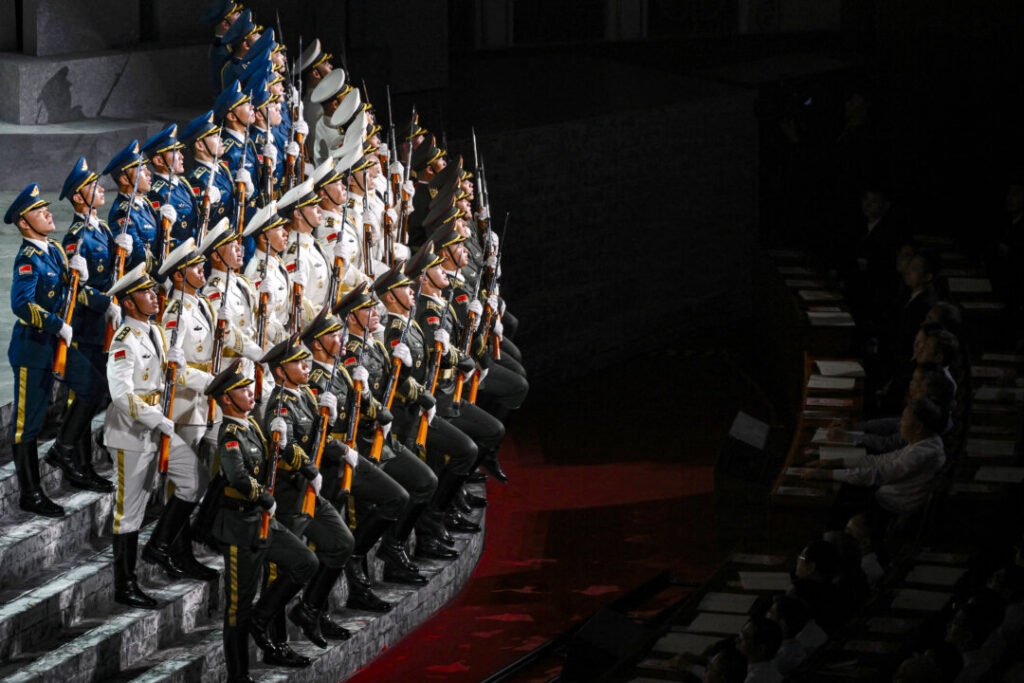
Artists take part in a performance at the Great Hall of the People, following a military parade marking the 80th anniversary of victory over Japan and the end of World War II, in Beijing on September 3, 2025. (Photo by WANG Zhao / AFP) (Photo by WANG ZHAO/AFP via Getty Images)
The Pentagon released its annual report to Congress on November 7, 2023, detailing the ongoing development of China’s military capabilities. This comprehensive 100-page document, a staple since 2000, assesses the growth of China’s armed forces and their potential roles in future conflicts. The report emphasizes China’s increasing military assertiveness, particularly regarding Taiwan.
One of the most significant findings is the assertion that China is preparing to use military force to assert control over Taiwan as early as 2027. This timeline aligns with the broader strategic objectives outlined by Chinese leadership, which has consistently signaled a willingness to resolve the Taiwan issue through military means if necessary.
Modernization and Expansion of Military Forces
The report indicates a clear trend in China’s military modernization, focusing on both traditional capabilities and emerging technologies. Over the years, there has been notable growth in the size and sophistication of China’s navy and nuclear forces. U.S. analysts are concerned that these advancements will enable China to operate more effectively in the Pacific region.
In addition to naval and nuclear enhancements, the Pentagon report highlights China’s recent strides in space and information technology. These advancements are not merely for defense; they are part of a broader strategy to challenge U.S. influence in the region and globally. The integration of advanced technologies into military operations signifies a shift toward a more modern and capable fighting force.
Furthermore, the Pentagon anticipates that by 2049, China aims to establish itself as a world-class military power. This long-term vision reflects President Xi Jinping’s ambition to enhance China’s status on the global stage. The modernization efforts underscore a commitment to not only expand military capacity but also to refine operational strategies that could be employed in various conflict scenarios.
Implications for Regional Stability
The findings of the Pentagon’s report raise significant concerns for regional and global stability. China’s focus on Taiwan, coupled with its military advancements, poses a challenge to the status quo in the Asia-Pacific region. The U.S. government is closely monitoring these developments, as they could impact diplomatic relations and security arrangements with allies in the region.
The report also highlights the need for continued U.S. engagement in the Asia-Pacific to maintain a balance of power. As China enhances its military capabilities, the U.S. is expected to bolster its own defenses and partnerships with regional allies to deter potential aggression.
In summary, the Pentagon’s latest report underscores a critical moment in U.S.-China relations, marking a period where military capabilities and intentions are increasingly intertwined with geopolitical strategies. The findings call for a thoughtful response from the international community to address the evolving security landscape in Asia and beyond.