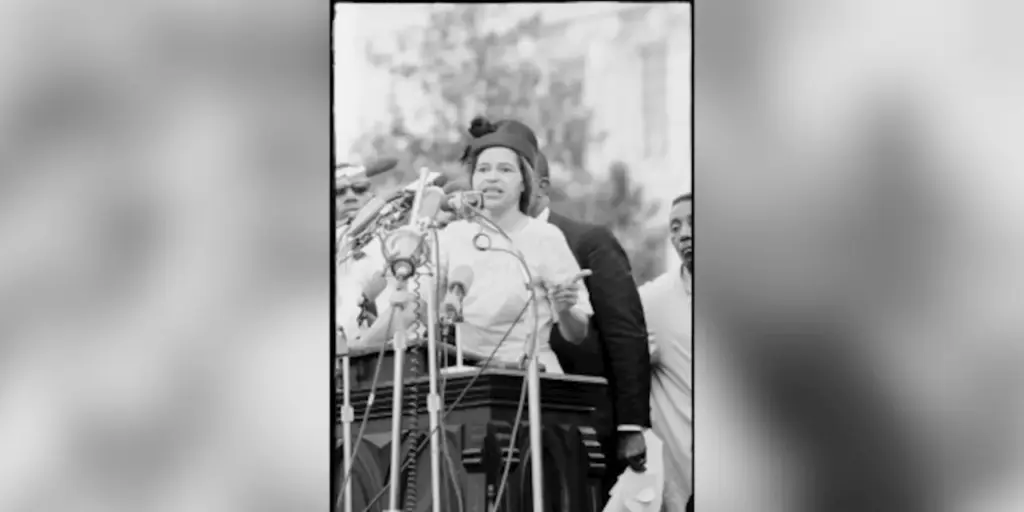
Seventy years after Rosa Parks made a pivotal stand against racial segregation by refusing to give up her bus seat in Montgomery, Alabama, previously unseen photographs of the Civil Rights icon have been revealed. These images, taken by the late photographer Matt Herron, showcase Parks during the historic Selma to Montgomery march in 1965, highlighting facets of her legacy that are not commonly recognized.
Revisiting a Legacy Through Photographic History
The newly disclosed photographs were made public at the Rosa Parks Museum in Montgomery, where they serve as a powerful reminder of Parks’ activism, which extended far beyond the well-documented bus boycott. Donna Beisel, the museum’s director, emphasized that these images illustrate Parks’ involvement in a broader struggle for civil rights.
Herron, known for chronicling the Civil Rights Movement, captured Parks among a crowd of fellow activists during the five-day, 54-mile march, a key event that galvanized the movement for voting rights. Many of Herron’s photographs had never been printed or displayed, as they were deemed blurry or featured lesser-known individuals, according to Jeannine Herron, the photographer’s widow.
These recently discovered images were found on a contact sheet located at Stanford University’s library, where they had been archived. Jeannine Herron is now collaborating with historians and surviving Civil Rights activists to reconnect these photographs with the communities they depict. “It’s so important to get that information from history into local people’s understanding of what their families did,” she stated.
A Personal Connection to History
One of Herron’s notable subjects during the Selma to Montgomery march was Doris Wilson, then a 20-year-old from Marion, Alabama. Wilson, who joined fellow residents at an event celebrating the photographs, expressed her surprise upon seeing images of herself that she had never encountered before. Among them was a poignant photograph depicting her receiving medical treatment for blisters sustained from the march.
At the event, Wilson was reunited with June Finer, the doctor who treated her injuries decades earlier. Their emotional exchange highlighted the enduring connections formed during that pivotal moment in history. “Are you the one who rubbed my feet?” Wilson asked, leading to laughter and an embrace, underscoring the personal stories intertwined with the broader narrative of the Civil Rights Movement.
Wilson’s son, Robert E. Wilson, reflected on the significance of the photographs, noting that he had never seen images of his mother during the march. “I’m so stunned. She always said she was in the march, but I never knew she was strong like that,” he remarked, illustrating the profound impact of these historical revelations.
Another attendee, Cheryl Gardner Davis, recalled her family’s experience hosting marchers at their home in Lowndes County, Alabama. Although she was just four years old at the time, she now comprehends the risks her family took to support the marchers, including threats to her mother’s job. Davis had spent years searching for photographic evidence of her family’s involvement and expressed gratitude for the newfound visibility of their contributions.
The release of these photographs not only enriches the historical narrative surrounding Rosa Parks but also highlights the collective efforts of countless individuals who played vital roles in the struggle for civil rights. As the community engages with this visual history, it serves as a reminder of the powerful legacy of activism and the importance of preserving these stories for future generations.