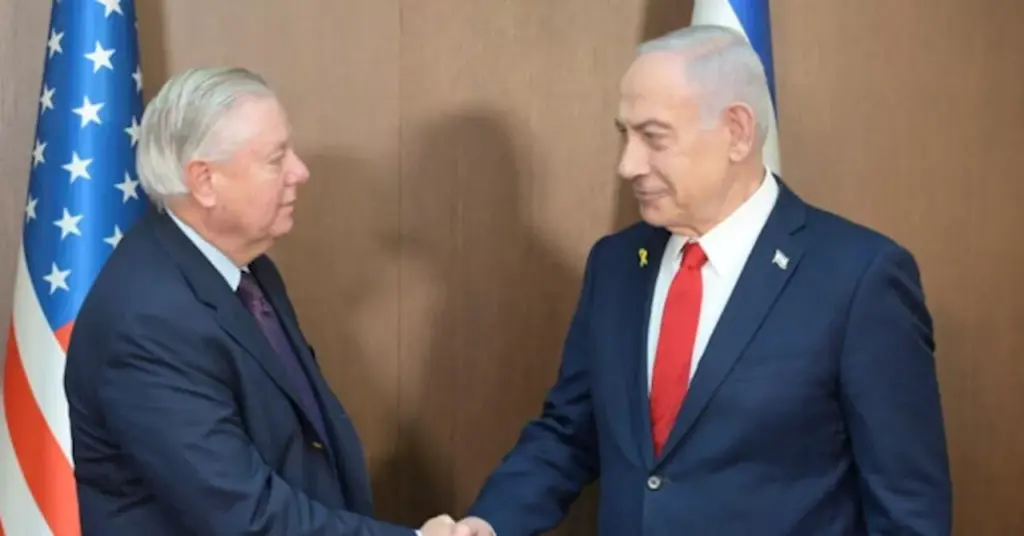
Senator Lindsey Graham has called for a formal defense pact between the United States and Israel, emphasizing the strategic advantages such an agreement would provide. During his recent visit to Israel, Graham highlighted the overwhelming support for Israel within the Republican Party and argued that U.S. aid to the country yields significant returns in terms of security and intelligence.
In statements made to reporters following meetings with Israeli leaders, including Prime Minister Benjamin Netanyahu and Foreign Minister Gideon Sa’ar, Graham framed Israel as a vital ally rather than a burden on American resources. He asserted, “The money we give Israel comes back tenfold in security, intelligence, and economic cooperation — especially in AI.” This underscores his belief that Israel plays a crucial role in maintaining U.S. security interests in the region.
Graham dismissed claims that support for Israel is waning within the Republican Party, stating that such assertions do not reflect political reality. He pointed to his home state, South Carolina, where over three-quarters of Republican voters support the U.S.-Israel relationship. “Support for Israel in the Republican Party is strong,” he noted, reinforcing the point that Israel’s security benefits the United States.
Strategic Cooperation and Military Support
The senator emphasized the importance of a formal U.S.-Israel defense agreement, suggesting it would institutionalize cooperation beyond the fluctuations of individual administrations. He stated, “Israel does more to keep America safe than almost any other ally,” and stressed that the current geopolitical landscape necessitates strong ties between the two nations.
Graham highlighted several key areas where Israel’s capabilities directly enhance American security, particularly in intelligence sharing and counterterrorism. He remarked, “If Israeli intelligence disappeared tomorrow, America would be blind in the region.” This statement underlines the critical nature of the partnership in addressing threats posed by groups such as Hamas and Hezbollah.
While commending Israel’s military effectiveness, Graham also pointed out the challenges the nation faces in the information space. He encouraged Israeli leaders to focus on their military objectives rather than seeking international approval. Addressing accusations of genocide, Graham contrasted Israel’s conduct with that of its adversaries, stating, “If Israel wanted to kill all Palestinians, it could. Hamas wants to kill all Israelis — but cannot.”
Addressing Regional Threats
Graham characterized Hamas, Hezbollah, and Iran as interconnected threats to both Israel and the United States. He warned that Hamas has used periods of ceasefire to rearm rather than disarm, complicating prospects for long-term peace. The senator noted that Hezbollah continues to destabilize Lebanon and has a history of violence against American forces, referencing the 1983 Beirut barracks bombing that resulted in the deaths of 241 U.S. service members.
He remarked, “Without Iran, there is no Hamas or Hezbollah,” indicating that the Iranian regime’s ambitions pose a persistent threat. Graham acknowledged the damage to Iranian nuclear facilities but emphasized that Tehran’s desire to challenge both Israel and the U.S. remains unchanged. He advocated for a robust response should Iran resume nuclear enrichment or expand its missile program, asserting, “Appeasement does not lead to peace.”
In closing, Graham proposed a timeline for Hamas to disarm, warning that failure to comply should lead to decisive military action backed by the U.S. He expressed a similar stance on Hezbollah, calling for the group to surrender its heavy weapons voluntarily or face coordinated military action. Such measures, he argued, would significantly enhance the potential for regional normalization and expanded peace agreements with Arab states.
Graham concluded his remarks by honoring the victims of the October 7 massacre and expressing hope that decisive action might reshape the region for the better. His statements reflect a commitment to a continued strong partnership between the United States and Israel, underscoring the importance of military and economic ties in addressing shared security challenges.