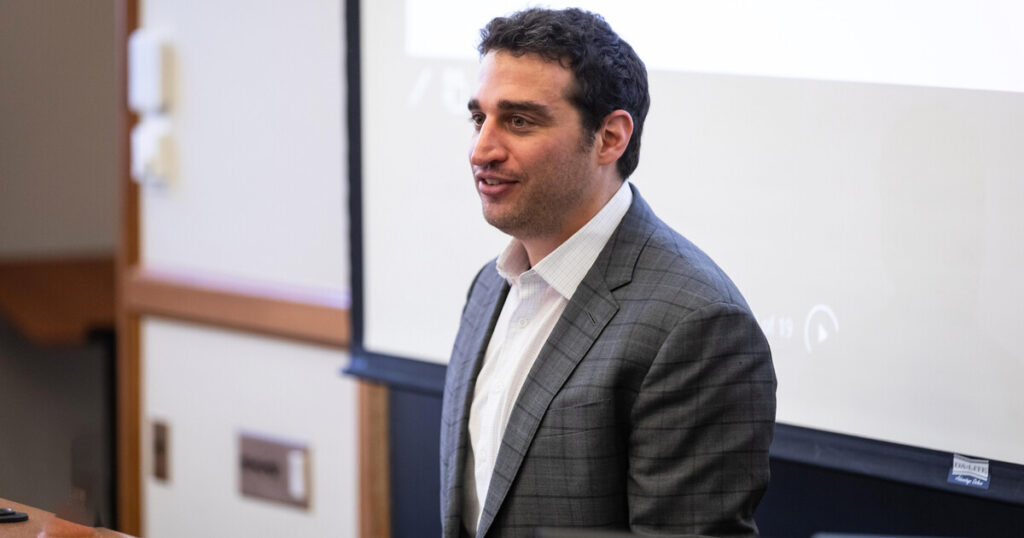
Professor of Law Joshua Macey, recently tenured in January 2026, is actively addressing the challenges facing the United States’ electric grid. His work at Yale Law School emphasizes strategies to enhance grid reliability and accelerate the transition to renewable energy sources. Macey’s advocacy comes at a time when extreme weather and power outages are increasingly common, raising significant concerns about the nation’s energy infrastructure.
Macey’s expertise spans bankruptcy, environmental law, and energy law, making him a pivotal figure in discussions about U.S. energy policy. In 2023, he was recognized by the American Bankruptcy Institute as one of its “40 Under 40 Emerging Leaders in Insolvency Practice.” His contributions to sustainability have also earned him the Morrison Prize for three consecutive years, highlighting the impact of his academic work.
The U.S. electric grid is under considerable strain, largely due to governance issues. Macey argues that the governance structures of the grid are outdated and hinder progress. “The infrastructure is under strain for many reasons, but governance is a significant factor,” he explains. These self-regulatory organizations, designed to manage wholesale electricity markets, are often controlled by incumbent utilities. This creates a conflict of interest, as these entities have a financial incentive to resist reforms that could increase competition from independent power producers.
Macey emphasizes that current regulatory frameworks do not adequately address the rising demand for electricity, particularly from data centers. He suggests that lawmakers must streamline the permitting process for new infrastructure. Additionally, he advocates for allowing data centers to generate their own energy when feasible. His recommendations include adopting a “connect and manage” approach, which would expedite the connection of new resources to the grid, allowing them to enter the market more quickly while accepting some operational risks.
Another critical issue Macey addresses is the monopolistic behavior of public utilities. He cites a specific case involving Duke Energy in North Carolina, illustrating how entrenched monopolies can engage in anticompetitive conduct that ultimately harms consumers. “Electric utilities are granted a legal monopoly, which they often exploit to gain an unfair advantage in the market,” he states. Macey argues that antitrust regulators need to be more proactive in enforcing laws that prevent such abuses. He believes that the Federal Energy Regulatory Commission (FERC) and the Department of Energy (DOE) lack the expertise necessary for effective antitrust regulation.
Macey advises students aspiring to enter the field of energy law to consider opportunities at both state and federal levels, as well as roles in national environmental nonprofits. He highlights the importance of state public utility commissions, where significant energy-related work is currently taking place. “Many key developments in energy policy are happening at the state level,” he notes, particularly for those focused on climate change and energy affordability.
As Macey continues to explore the intersection of law and energy policy, his work illuminates the pressing need for reforms that enhance the reliability of the U.S. power grid. His insights serve as a call to action for lawmakers, regulators, and future legal professionals to engage with the complexities of energy governance and strive for a more sustainable and equitable energy future.