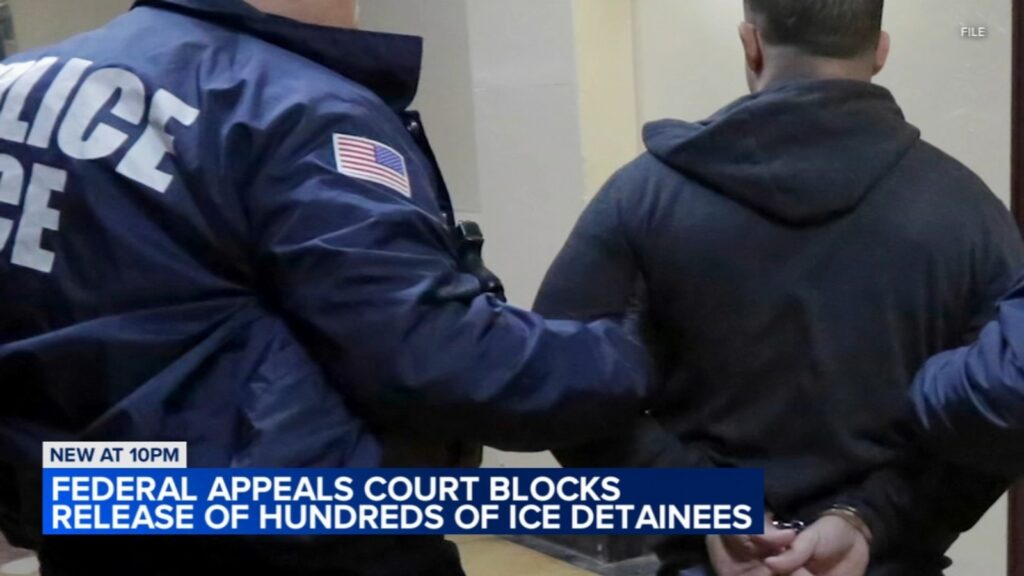
A federal appeals court has intervened to block the release of hundreds of individuals detained by immigration agents during “Operation Midway Blitz” in the Chicago area. The decision comes as the court evaluates whether the government violated a consent decree that prohibits warrantless arrests in specific circumstances. The appeals court ruled that each detainee’s situation must be assessed individually.
U.S. District Judge Jeffrey Cummings previously ordered the release of hundreds of migrants arrested under the Department of Homeland Security’s (DHS) operation by November 21, 2025. He found that their arrests may have breached a 2022 consent decree designed to limit warrantless arrests by federal agents. Judge Cummings sided with the American Civil Liberties Union (ACLU) and the National Immigrant Justice Center (NIJC), which represented detainees alleging violations of their rights.
The judge mandated the release of 13 individuals by Friday at noon, with an additional 615 individuals to be released into “alternatives-to-detention,” including electronic monitoring, by next Friday unless the government files an appeal or takes further action by the specified deadline. According to the NIJC, these detainees were apprehended by Immigration and Customs Enforcement (ICE) agents between June 11 and October 7, 2025. Those under alternatives-to-detention will remain outside detention facilities while their cases are reviewed to determine if their arrests were lawful under the consent decree.
“This will allow a lot of people to return to their communities because they never should have been arrested in the first place,” stated Michelle Garcia, an attorney with the ACLU. The judge has also directed the Trump administration to provide comprehensive information on all arrests made since October 7, which will help assess the legality of those detentions and halt deportation proceedings for individuals awaiting release.
Individuals with prior removal orders or those deemed a significant public risk will not be eligible for release, according to attorneys involved in the case. Judge Cummings remarked that had federal agencies adhered to the law and the consent decree, there would be “nothing for him to order.” He emphasized that individuals without criminal histories and who were unlawfully arrested should be released.
The 2022 Castañon Nava consent decree remains in effect until February 2026 and covers Illinois and five neighboring states. Last month, Judge Cummings ruled that federal immigration agents had violated this agreement during the recent immigration operation. The decree restricts federal agents from executing warrantless arrests unless there is belief that a person is in the country illegally and is also a flight risk.
In response to the ruling, a DHS spokesperson claimed that the judge’s order compromises public safety. Tricia McLaughlin, Assistant Secretary of the DHS, criticized the decision, arguing that it endangers Americans by releasing individuals the department deems a risk.
The judge also instructed the Department of Justice to evaluate all remaining arrests from October 7 to the present that may involve similar violations of the consent decree, with findings to be submitted within a week. As the case unfolds, more detainees could qualify for release.
Legal representatives from both sides are actively working to identify how many individuals were apprehended by immigration agents in violation of the consent decree. Mark Fleming from the NIJC believes that such violations occur frequently. “I think our review will show that this whole operation, for the last two months, has terrorized our neighborhoods and that the arrests have been unlawful,” he stated.
Fleming added that their initial assessment indicates over 3,000 arrests may have involved violations of the consent decree. So far, ICE has reported a list of 3,800 individuals arrested, while U.S. Customs and Border Protection has provided a list of 1,200 individuals. Attorneys highlight the potential for duplicate entries, complicating efforts to establish an accurate total.
Government attorneys contend that Congress has removed the authority of federal courts to grant parole to large groups of immigrants in ICE custody. They argue that the Secretary of Homeland Security alone possesses that power, thus limiting judicial intervention in these cases.
In their investigations, Fleming noted that over 1,000 individuals are no longer in the United States, possibly having been deported after signing voluntary removal orders. “Many of these individuals have never had previous interactions with law enforcement, making their detention particularly troubling,” he explained.
Fleming warned that failing to provide interim relief may lead to the loss of potential claims against unlawful arrests. “At the end of this, we may discover numerous violations, but there may be no one left to represent,” he concluded.