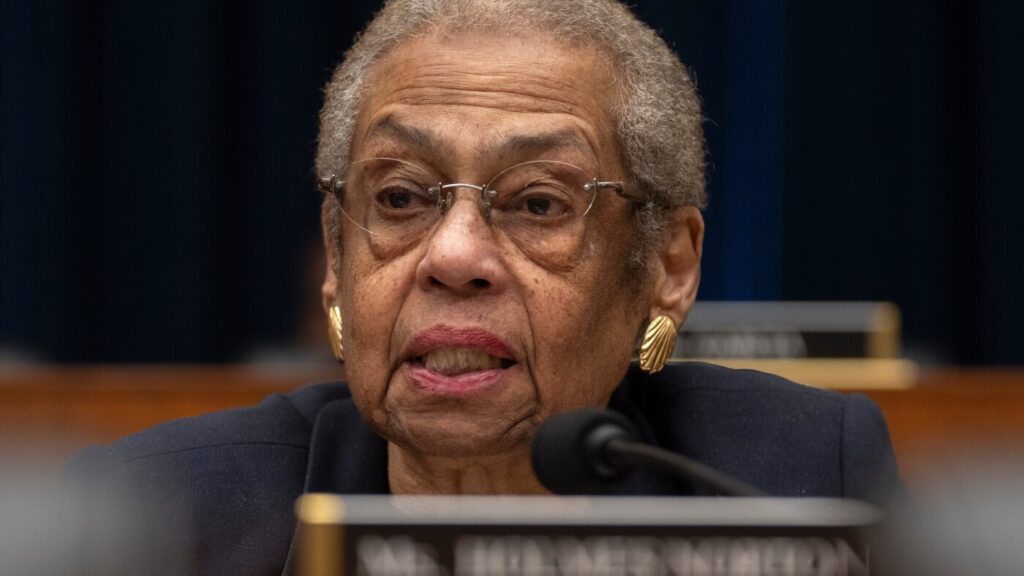
FILE - Del. Eleanor Holmes Norton, D-D.C., speaks during a hearing of the Aviation Subcommittee of the House Transportation and Infrastructure Committee on Capitol Hill, Dec. 16, 2025, in Washington. (AP Photo/Mark Schiefelbein, File)
Eleanor Holmes Norton, the long-serving delegate for the District of Columbia, has officially concluded her campaign for reelection, marking a significant moment in her decades-long career in public service. At the age of 88, Norton has represented the residents of the nation’s capital in Congress since 1991, making her one of the most prominent figures in Washington politics. Her campaign submitted termination paperwork to the Federal Election Commission on Sunday, signaling her retirement from a role that has been pivotal in advocating for D.C. interests.
Norton faced increasing scrutiny regarding her effectiveness in Congress, particularly following the Trump administration’s controversial interventions in the district. These actions included federalizing the local police force and deploying National Guard troops, which raised concerns among residents and local officials. Washington’s Mayor, Muriel Bowser, publicly praised Norton for her enduring commitment to the city, referring to her as a “Warrior on the Hill” on social media. Bowser emphasized Norton’s unwavering resolve in the pursuit of equal representation for D.C. residents.
In her role as a delegate, Norton does not possess a formal vote in the House, yet she has been a tireless advocate for D.C. statehood and the rights of federal workers in the area. Her advocacy efforts have resulted in significant legislative victories, such as a law that enables D.C. residents to attend public colleges at in-state tuition rates or receive grants for private university attendance. Norton also played a crucial role in addressing the city’s financial crisis in the 1990s by negotiating a deal that transferred billions in unfunded pension liabilities to the federal government.
A Legacy of Civil Rights Advocacy
Norton’s journey in public service is deeply intertwined with her history in the civil rights movement. Born and raised in Washington, she was part of Dunbar High School’s last segregated class. She later attended Antioch College and was actively involved in the Civil Rights Movement, including participating in the 1963 March on Washington. Norton was a close associate of civil rights leaders, including Medgar Evers, who was assassinated shortly after picking her up at the airport during the Freedom Summer.
Throughout her career, Norton has served as a mentor and ally to numerous activists and lawmakers, including fellow congressmen such as Jim Clyburn and the late John Conyers and John Lewis. Her contributions have not only shaped the legislative landscape of D.C. but have also left a lasting impact on the national stage.
Norton’s retirement opens the door for a competitive primary to replace her in a city that predominantly supports Democratic candidates. Several local lawmakers have already announced their intentions to run in the upcoming primary, eager to fill the significant void left by her departure.
As more than 10% of House members decide against seeking reelection this year, Norton’s exit highlights a broader trend among lawmakers. The political landscape continues to evolve, and her retirement leaves a legacy of advocacy for representation and civil rights that will be challenging to replicate.
In an interview earlier this year, Norton reflected on her lifetime of public service and activism, noting that her experiences have profoundly shaped her approach to politics. Her commitment to the residents of D.C. and her role in the ongoing fight for statehood will remain pivotal as the city navigates its political future without her leadership.