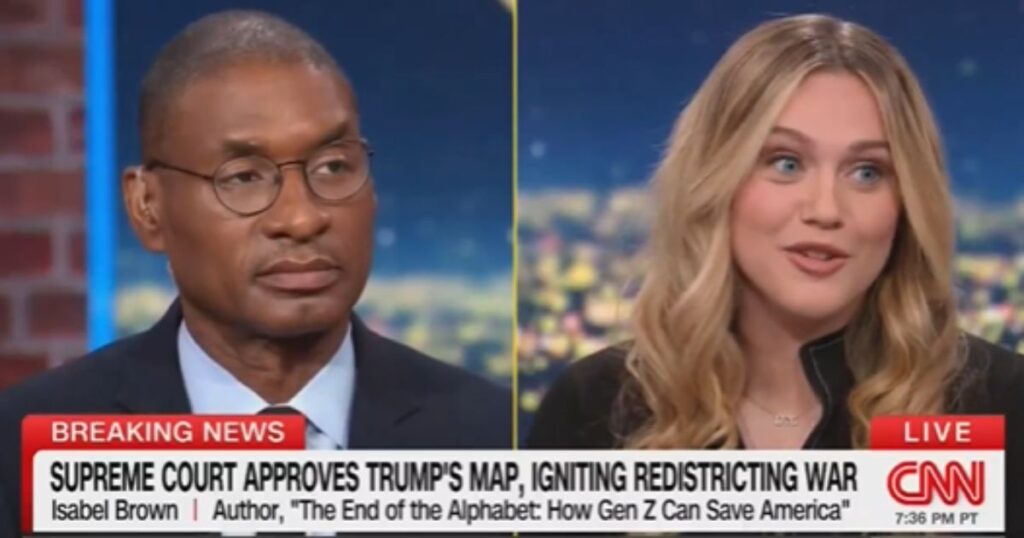
Former New York Times columnist Charles Blow faced a significant rebuttal during a heated discussion on congressional redistricting on CNN. The exchange occurred on “CNN NewsNight” as Blow accused conservative podcaster Isabel Brown of racism for her comments regarding the ongoing redistricting efforts in the United States. This follows the Supreme Court’s decision to permit Texas to implement new congressional maps, which became a contentious topic in the wake of political maneuvers by Texas Democrats.
During the segment, Brown criticized the notion of race being used as a political weapon, labeling it “really pathetic.” She highlighted that California is engaging in similar tactics to increase Democratic representation in Congress, stating, “Breaking news, a Republican state tried to create more Republican congressional seats under a Republican governor and conservative legislature.” She emphasized that California, now viewed as one of the most Democratic states, has seen significant shifts in its political landscape, including many conservatives leaving under the leadership of Governor Gavin Newsom.
Blow argued that denying the existence of racism in the redistricting process reflects poorly on individuals making such claims. He insisted that the creation of districts favoring Republicans disenfranchises minority groups. “How did they do it? By disenfranchising black and brown people,” he contended, challenging Brown to address this issue.
In response, former Republican City Councilman Joe Borelli of New York City pointed out the disparity between the percentage of Californians who voted for Donald Trump—approximately 40 percent—and the number of Republican representatives in Congress from the state, which stands at just nine out of fifty-one. Borelli remarked, “There are no Republicans in any district in New England,” further illustrating the skewed representation as a result of redistricting practices.
Redistricting occurs every ten years following the national Census and is essential for adjusting congressional districts based on population changes. Following the 2022 midterm elections, New York redrew its congressional districts, which placed several Republican seats at risk, highlighting the contentious nature of this political process.
Borelli further elaborated on the partisan nature of redistricting, recalling how Connecticut’s first district was redrawn in a manner that fragmented Republican representation into separate districts. He noted, “So again, this is, as Isabel pointed out, a Republican state doing what Republican states tend to do, just like what Democrat states tend to do.”
The conversation reflects broader tensions in U.S. politics surrounding electoral representation and the strategies employed by both parties to secure their interests. The Supreme Court’s involvement in these matters continues to shape the landscape of American democracy, influencing how political boundaries are drawn and how representation is allocated.
The ongoing debate over redistricting underscores the significance of maintaining fair representation in Congress, especially as political landscapes evolve in response to demographic changes and electoral shifts.