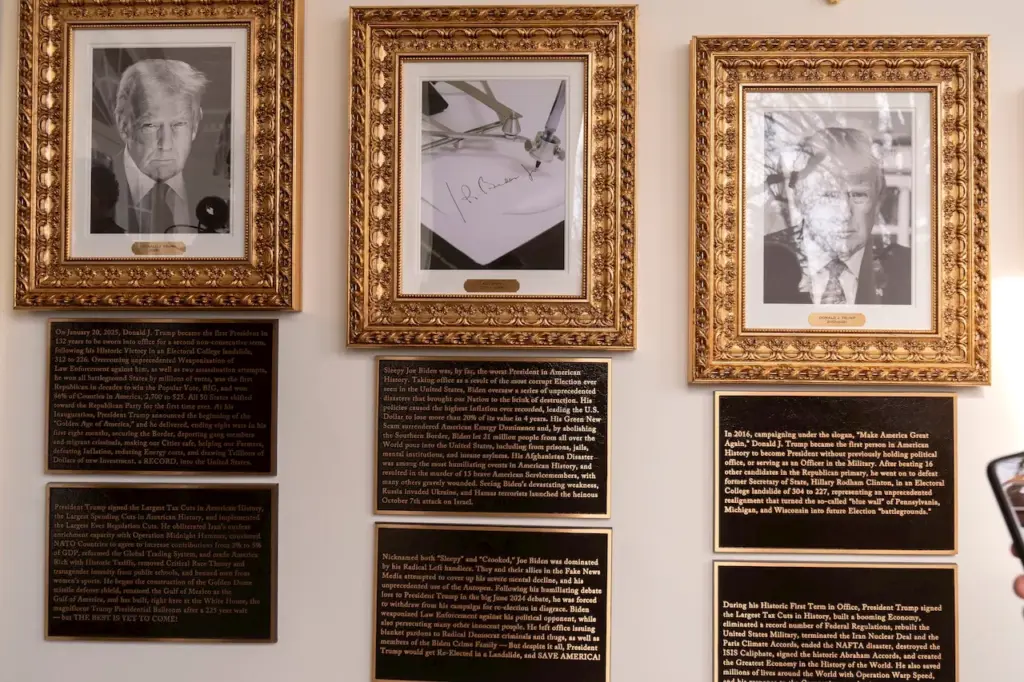
Brian Kilmeade, a host at Fox News, has expressed concern regarding the recent installation of politically charged plaques beneath the portraits of former Presidents Barack Obama and Joe Biden at the White House. The plaques, which are part of an informal “Walk of Fame” established during Donald Trump‘s presidency, contain critical commentary about both leaders.
On December 17, 2025, the plaques were unveiled on the Colonnade of the White House, featuring inflammatory statements that reflect Trump’s perspective on his predecessors. The plaque dedicated to Biden includes claims about the 2020 election, stating, “Taking office as a result of the most corrupt Election ever seen in the United States, Biden oversaw a series of unprecedented disasters that brought our Nation to the brink of destruction.” The plaque also depicts an image of an autopen, highlighting Trump’s allegations regarding the election’s integrity.
The plaque beneath Obama’s portrait refers to him as “one of the most divisive political figures in American History,” criticizing his administration’s policies, particularly the Affordable Care Act. It states, “He crippled small businesses with crushing regulation and environmental red tape, devastated American coal miners, and weaponized the IRS and Federal bureaucracies against his political opponents.”
Kilmeade’s Dissenting View
Brian Kilmeade’s reaction stands in contrast to that of fellow Fox News commentator Jesse Watters, who dismissed the plaques as Trump “having a little fun” with presidential history. Kilmeade suggested that the plaques should simply display the portraits without the accompanying critiques, arguing against the need to include such contentious remarks. “I am not for dispelling or saying anything bad,” he stated, emphasizing a more neutral approach to historical representation.
He also reflected on the legacy of presidents, noting that some figures, once deemed poor leaders, like Ulysses S. Grant, have later been reevaluated positively. Kilmeade remarked, “I don’t think it’s going to happen with Joe Biden, but I am not for the trolling.” His comments highlight a growing divide within political commentary regarding how contemporary leaders should be portrayed in historical contexts.
The Broader Implications
The installation of these plaques has sparked broader discussions regarding political discourse in the United States. Critics argue that such actions undermine the dignity of the office and promote a culture of division rather than unity. Supporters of Trump, on the other hand, view the plaques as a bold statement of his administration’s stance against what they perceive as the failures of the previous administrations.
As political tensions remain high, the decision to include these controversial plaques at the White House may serve as a focal point for ongoing debates about historical interpretation and the role of political commentary in public spaces. The implications of this move extend beyond the walls of the White House, potentially influencing how future generations perceive the Trump presidency and its legacy.
As the nation continues to grapple with its political climate, Kilmeade’s remarks reflect a noteworthy perspective that challenges the more combative narratives often associated with Trump’s time in office. The discourse surrounding these plaques serves as a reminder of the complexities involved in representing political history and the lasting impact of such representations on public perception.