A recent poll conducted by AP-NORC reveals that a significant majority of Americans express concern regarding Iran’s nuclear program while simultaneously questioning President Donald Trump‘s capability to manage foreign affairs. The poll, carried out from February 19 to 23, 2023, highlights a stark division in public opinion as critical nuclear negotiations unfold between the United States and Iran.
The findings indicate that 80% of U.S. adults harbor at least a moderate level of concern about the threat posed by Iran’s nuclear ambitions. Among this group, 48% report being very or extremely concerned. This sentiment is particularly pressing as the current negotiations, led by Trump‘s envoys, Steve Witkoff and Jared Kushner, with Iranian Foreign Minister Abbas Araghchi, could represent a pivotal moment for U.S.-Iran relations.
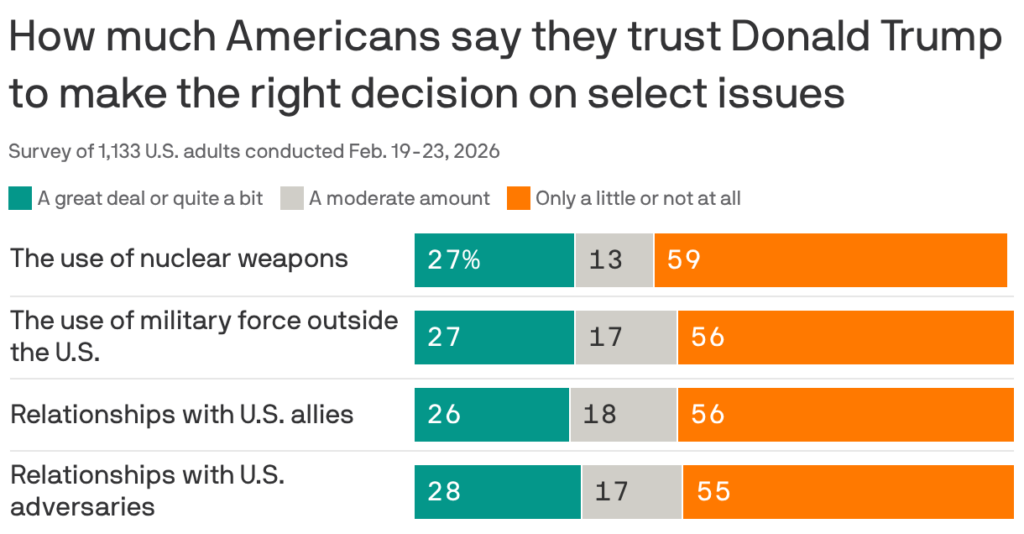
Despite the high levels of concern regarding Iran, 56% of those surveyed indicated they do not trust Trump to make sound decisions regarding international military actions. This skepticism spans across party lines, with 16% of Republicans expressing little to no faith in his military judgment. Among Democrats, that figure rises to 92%, while 65% of independents share similar sentiments.
The implications of these findings are significant, as Trump has previously ordered various military operations, including strikes aimed at Iran’s nuclear facilities and raids targeting foreign leaders like Venezuelan President Nicolas Maduro. Recently, the Pentagon has undertaken a substantial military build-up in the Middle East, marking one of the largest deployments in decades.
In a recent State of the Union address, Trump expressed a preference for diplomacy over military action regarding Iran. He stated, “My preference is to solve this problem through diplomacy. But one thing is certain, I will never allow the number one state sponsor of terrorism to have a nuclear weapon.” This statement reflects the administration’s dual approach of seeking diplomatic solutions while preparing for possible military responses.
As the negotiations continue, the stakes are high. The poll underscores a growing anxiety among the American populace about the potential for conflict and the effectiveness of the current administration’s strategies. With a margin of error of ±4 percentage points, the survey of 1,133 adults offers a snapshot of a nation grappling with complex international challenges.
The outcome of these discussions may shape not only U.S.-Iran relations but also influence domestic perceptions of Trump‘s leadership as he navigates a critical juncture in foreign policy.