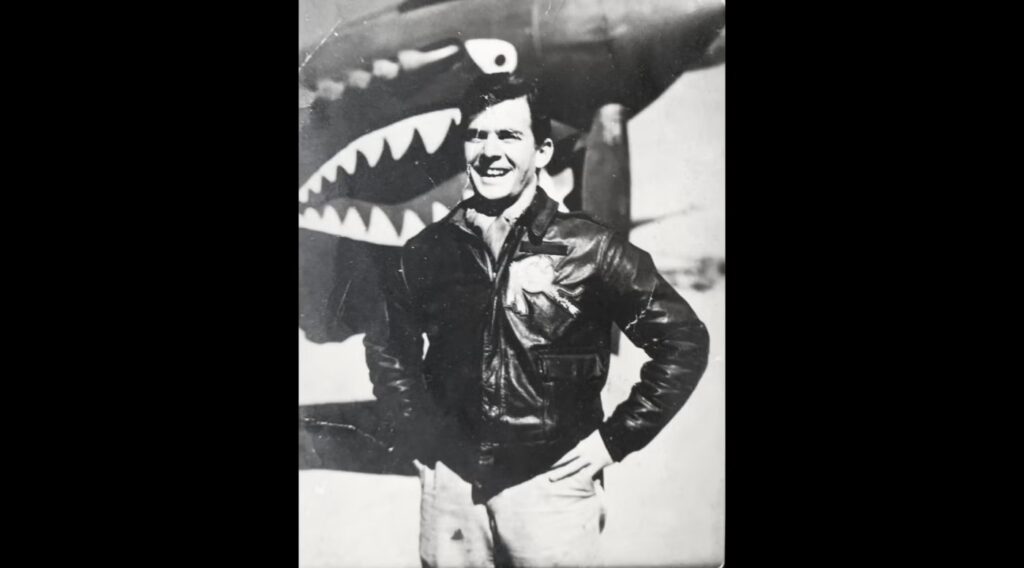
An American Jewish fighter pilot, Lieutenant Morton Sher, has been laid to rest 82 years after his plane was shot down during World War II. The burial took place on December 14, 2023, in Greenville, South Carolina, coinciding with what would have been his 105th birthday. His remains, identified earlier this year, were interred with full honors, marking a significant moment for his family and the community.
Sher was part of the elite group known as the “Flying Tigers,” formed to defend China against Japanese aggression following the attack on Pearl Harbor in 1941. On August 9, 1943, while piloting a P-40 Warhawk, Sher’s aircraft was shot down by Japanese bombers over Chinese territory. His mother, Celia, was awarded Sher’s Purple Heart that same year, recognizing his sacrifice.
In the years following his death, Sher’s squadron established a memorial stone at the crash site located in Xin Bai Village. A military review conducted in 1947 concluded that his remains were likely destroyed and deemed unrecoverable. Despite two attempts to locate Sher’s remains in 2012 and 2019, these efforts yielded no results.
A breakthrough occurred in 2024 when the Defense POW/MIA Accounting Agency excavated the crash site in the province where Sher’s plane had fallen. Subsequent DNA analysis confirmed the identification of his remains in June 2025, leading to the eventual burial.
Born on December 14, 1920, in Baltimore, Maryland, Sher’s family later relocated to Greenville, where they became active members of the Conservative synagogue, Congregation Beth Israel. As a student, Sher was involved in the aviation club and participated in the ROTC program. He was also a founding member of the Aleph Zadik Aleph chapter of the B’nai B’rith Youth Organization in Greenville.
Steve “Morton” Traub, Sher’s nephew, shared his reflections with a local NBC station, expressing admiration for his uncle’s service. “He dreamed of being a pilot. This guy did a lot for his country. He was my hero,” Traub stated. Although he never met Sher, he grew up hearing stories and reading letters from his uncle. “I wish I had known him,” Traub added, “but if he had, I wouldn’t have been named after him. I feel like I knew him because I knew Papa.”
The burial of Lieutenant Morton Sher not only honors his legacy but also serves as a reminder of the sacrifices made by countless servicemen and women during one of history’s most significant conflicts.