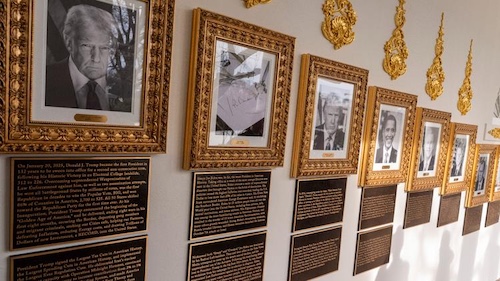
On January 3, 2026, President Donald Trump introduced a controversial exhibit called the Presidential Walk of Fame at the White House. This initiative aims to commemorate his presidency while reshaping the narrative of U.S. history. Critics, including the Associated Press, describe the project as Trump’s attempt to reframe the legacy of American presidents, emphasizing his achievements and downplaying those he views unfavorably.
The Walk of Fame includes two displays that feature plaques celebrating Trump’s tenure. One plaque boasts of what Trump claims to be “the Greatest Economy in the History of the World” and refers to his 304-227 Electoral College victory in 2016 as a “landslide.” Another plaque highlights Trump’s popular vote win in the 2020 election, a milestone he did not achieve in his first campaign, concluding with the phrase “THE BEST IS YET TO COME.”
The introductory plaque describes the exhibit as “conceived, built, and dedicated by President Donald J. Trump as a tribute to past Presidents, good, bad, and somewhere in the middle.” Karoline Leavitt, White House Press Secretary, stated that the plaques contain “eloquently written descriptions of each president and the legacy they left behind,” many of which were authored by Trump himself.
Trump’s interpretations of his predecessors vary significantly. For instance, he labels Joe Biden as “Sleepy Joe” and claims he is “by far, the worst President in American History,” attributing blame for significant national challenges to his administration. He asserts that Biden’s leadership brought the nation “to the brink of destruction” and calls into question the legitimacy of Biden’s election.
In contrast, Barack Obama is framed by Trump as “one of the most divisive political figures in American History.” Trump critiques Obama’s signature legislation, labeling the Affordable Care Act as “highly ineffective.”
While acknowledging some achievements of George W. Bush, including the establishment of the Department of Homeland Security after the September 11 attacks, Trump condemns his decision to engage in military conflicts in Afghanistan and Iraq. Meanwhile, Bill Clinton, who once had a friendly relationship with Trump, receives mixed reviews; he is credited for the tech boom of the 1990s but is reminded of the scandals that marred his presidency. Clinton’s plaque humorously notes that his wife, Hillary Clinton, lost the presidency to Trump in 2016.
The plaques also provide a nod to various historical figures, offering praise where Trump sees fit. He acknowledges Lyndon Johnson for advancing civil rights legislation and John F. Kennedy as a World War II hero who inspired Americans through his rhetoric against communism.
Notably, the exhibit does not shy away from addressing the Watergate scandal that led to the resignation of Richard Nixon, reinforcing the complexities of presidential legacies. Trump also utilizes the occasion to criticize the media, asserting that Andrew Jackson was treated unfairly by the press, drawing parallels to his own experiences.
The initiative has drawn attention not just for its content but also for its implications regarding Trump’s ongoing influence on American culture and politics. A recent Reuters article highlighted how Trump’s name has become synonymous with various projects and initiatives across the United States, raising questions about the permanence of his branding in political and public life.
Critics like Austin Sarat, a professor at Amherst College, speculate on the future of Trump’s legacy, questioning whether his name will endure should political tides shift in favor of his opponents. The Presidential Walk of Fame stands as a testament to Trump’s desire to leave a lasting mark on the White House and American history, a move that will likely fuel ongoing debates about the legacy of presidential leadership in the United States.