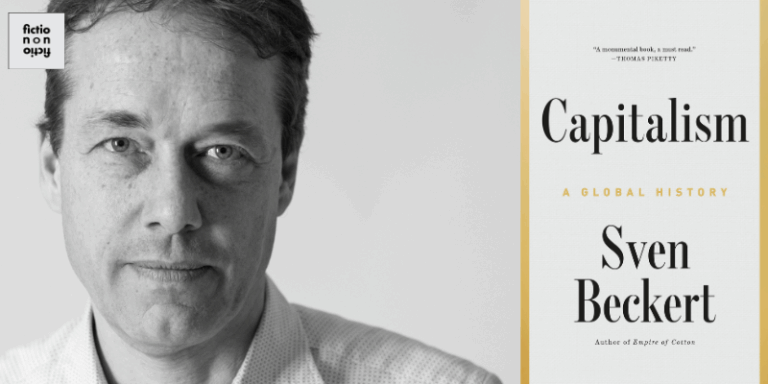
Pulitzer Prize finalist Sven Beckert recently joined co-hosts Whitney Terrell and V.V. Ganeshananthan on the podcast “Fiction/Non/Fiction” to discuss his new book, Capitalism: A Global History. In this insightful conversation, Beckert offers a profound exploration of capitalism as an ongoing process that shapes our daily interactions and influences various aspects of life across the globe.
Beckert describes capitalism as a force comparable to geological changes, emphasizing its historical significance over the past thousand years. He notes that this economic system has been shaped by a wide array of individuals—from merchants and CEOs to those resisting oppression—highlighting its complex and multifaceted nature. The discussion delves into capitalism’s dual role in fostering technological innovation while simultaneously creating devastating global consequences.
In particular, Beckert addresses the pervasive issue of inequality within capitalist systems. He urges for a more nuanced understanding, arguing that capitalism is not an immutable fact but rather a human-made construct that can be altered. He states, “Inequality is not an invention of capitalism… but the forms that inequality has taken have shifted drastically over time.”
Lessons from History on AI and Labor
As the conversation shifts to contemporary issues, particularly the rise of artificial intelligence (AI), Beckert draws parallels between historical shifts in capitalism and current technological advancements. He notes that while AI is a relatively recent development, its potential impact echoes past technological revolutions, such as the steam engine and the automobile.
Beckert emphasizes that historical patterns can offer insights into how society might adapt to AI’s integration into the workforce. He points out that significant productivity gains have historically been distributed unevenly, stating, “If we look at the computer revolution of the 2000s, we see that productivity gains were captured by a small part of American society.”
The discussion raises critical questions about the distribution of benefits arising from AI. Beckert argues that the focus should not solely be on whether AI is good or bad, but rather on who stands to gain from these advancements. He suggests that AI could potentially enhance productivity and improve living standards, but emphasizes that these outcomes depend on political decisions regarding wealth distribution.
The Future of Capitalism and Inequality
The podcast also addresses the pressing issue of wealth concentration, which Beckert notes has historical precedents. He cites a period between 1880 and 1914 when a small percentage of the population in countries such as France, Britain, and Sweden controlled the majority of national wealth. This historical context prompts a reflection on current economic disparities and the potential for change.
Beckert stresses that the current trajectory of inequality, exacerbated by technological advancements, is unsustainable within a democratic framework. He argues that while capitalism can lead to significant societal benefits, it can also foster extreme inequality if left unchecked.
In closing, Beckert expresses cautious optimism, reminding listeners that today’s society possesses the resources to address its material challenges. “We live in what is probably the richest society in the history of humanity,” he states, underscoring the potential to provide for all citizens. By recognizing capitalism as a construct that can evolve, he encourages a re-examination of economic systems and the possibilities for a more equitable future.
To hear the full discussion, listeners can subscribe to “Fiction/Non/Fiction” through platforms such as iTunes, Google Play, Stitcher, and Spotify. Video versions of the interview are also available on the show’s Instagram and YouTube channels, as well as on its official website.