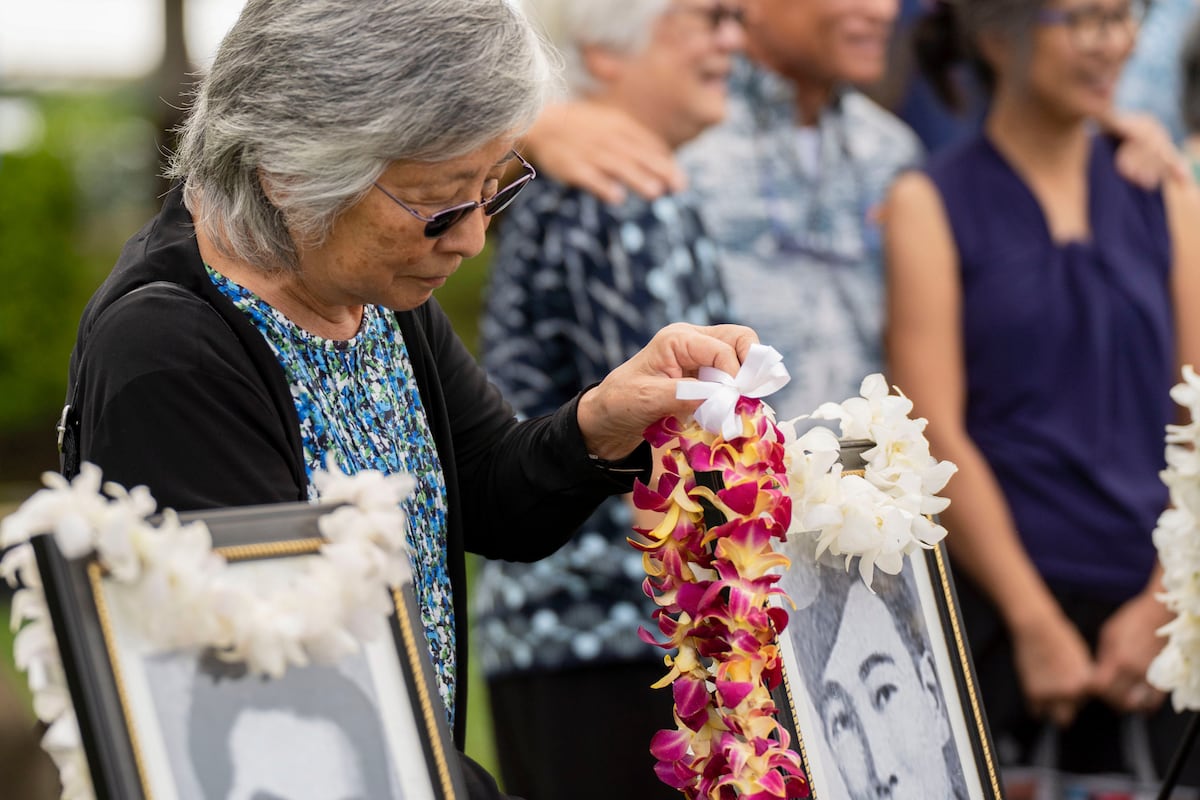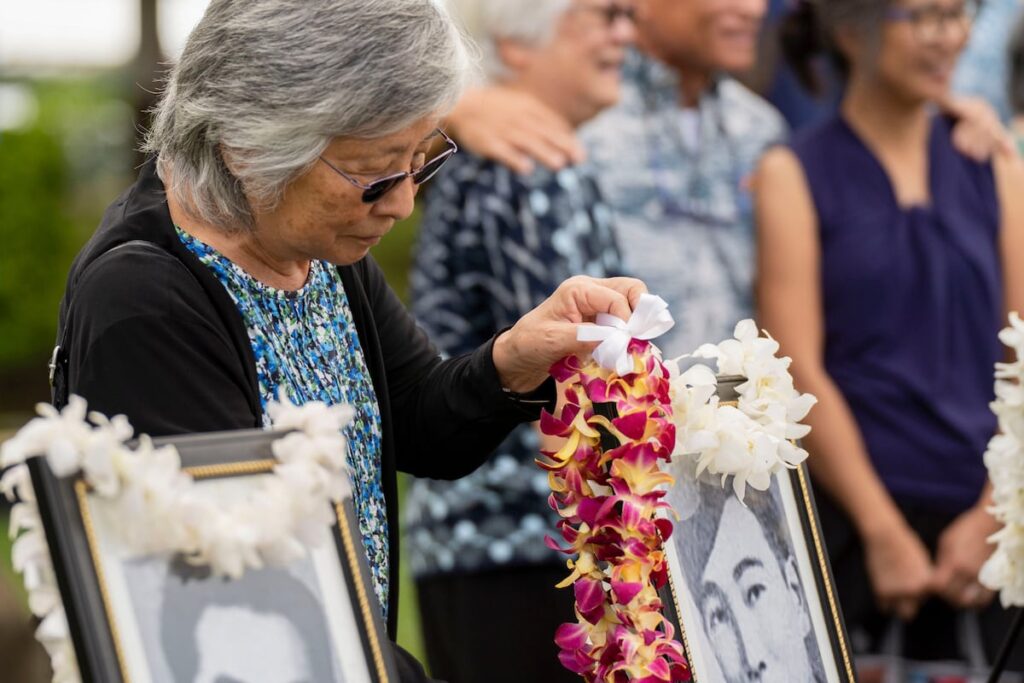
Seven Japanese American soldiers were posthumously promoted to officer ranks during a ceremony in Honolulu on March 4, 2024. This event took place eight decades after these men fought valiantly for the United States during World War II, despite the stigma of being labeled “enemy aliens.” Family members gathered under tents to shield themselves from rain, which paused just as the ceremony commenced, while white flower lei adorned framed photographs of the soldiers.
The seven men—Daniel Betsui, Jenhatsu Chinen, Robert Murata, Grover Nagaji, Akio Nishikawa, Hiroichi Tomita, and Howard Urabe—were students at the University of Hawaii and cadets in the Reserve Officer Training Corps when Japan attacked Pearl Harbor on December 7, 1941. Initially serving in the Hawaii Territorial Guard, they faced discrimination following the attack. The U.S. government barred most Japanese Americans from military service, categorizing them as enemy aliens.
As a result, these seven cadets joined the civilian labor battalion known as the “Varsity Victory Volunteers.” This group performed essential tasks, including digging ditches and breaking rocks, until the U.S. Army announced the formation of a segregated Japanese American regiment in early 1943. The seven men subsequently joined the 442nd Regimental Combat Team, a unit that, along with the 100th Battalion, became one of the most decorated in U.S. military history.
During their service, many members of the 442nd fought valiantly for the Allies, even while their own families were detained in Japanese American internment camps. “It is important for us to really kind of give back and recognize our forefathers and these veterans that we stand on the shoulders of,” stated 1st Sgt. Nakoa Hoe of the 100th Battalion, 442nd Regiment. He emphasized the unit’s diverse makeup today compared to its segregated past.
The soldiers who were honored in the ceremony all made the ultimate sacrifice, with most falling during the 1944 campaign to liberate Italy from Nazi forces. Robert Murata was killed by an artillery shell in eastern France, while the others lost their lives fighting in Italy. Murata’s nephew, Todd Murata, expressed pride in his uncle’s legacy. “It’s an honor to be related to one of those people, those men, who volunteered for service,” he remarked. “After all these years, people still remember them.”
June Harada, the niece of Howard Urabe, echoed these sentiments, highlighting the ceremony as a step towards healing historical injustices. “It’s nice to have our uncle recognized for this huge sacrifice that he made,” she noted, reflecting on the pride many descendants feel in their family’s military contributions.
Although Hawaii was not yet a state during World War II, these cadets were American citizens, having been born in Hawaii after its annexation in 1898. The promotion ceremony is part of broader efforts to honor these soldiers, particularly in light of current debates surrounding the teaching of American history. Concerns have emerged regarding potential attempts to downplay the contributions of minority groups as the nation prepares to celebrate 250 years of independence.
In recent years, the Pentagon faced scrutiny for removing online pages that recognized Black Medal of Honor recipients and Japanese American service members. Critics argue this reflects a broader trend of diminishing the narratives of marginalized communities. Lt. Col. Jerrod Melander, who led the University of Hawaii’s ROTC program, explained that honoring these soldiers is about merit and recognition of their sacrifices. “They served in the ultimate capacity of giving their lives for the country,” he stated.
The posthumous promotions to the rank of 2nd lieutenant, equivalent to what they would have attained had they completed the ROTC program, were initiated in 2023 and approved in 2024. The University of Hawaii previously awarded the men posthumous degrees in 2012, acknowledging their contributions and sacrifices in a chapter of American history that remains vital today.