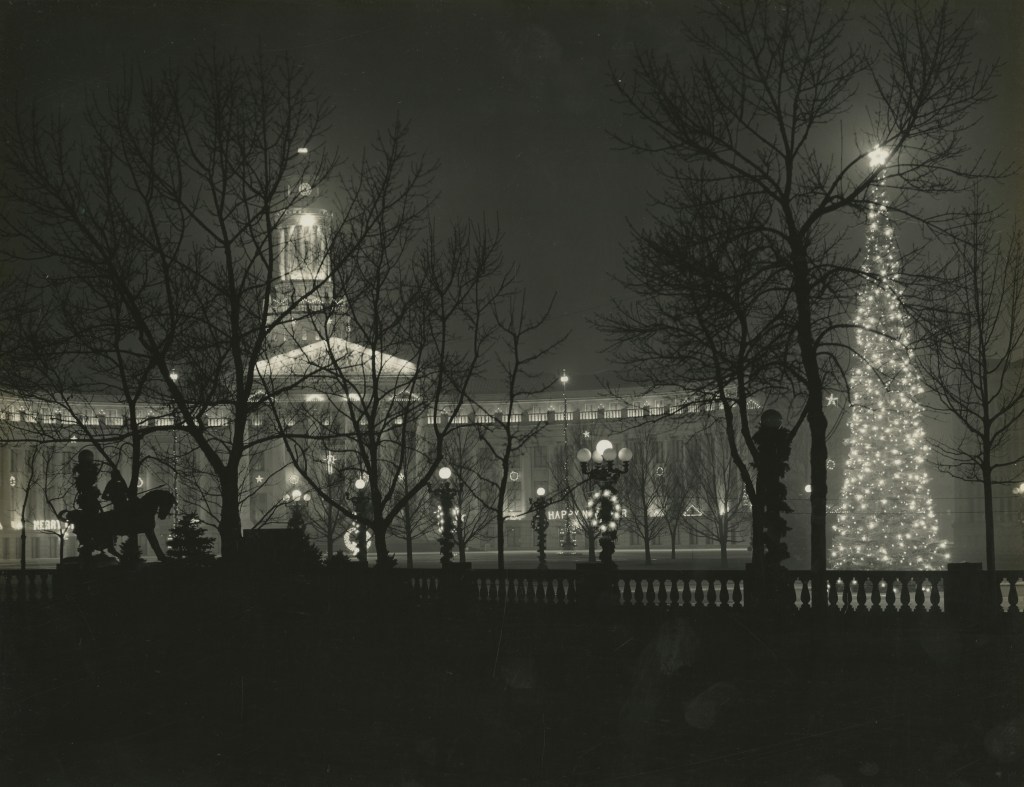
In 1914, a creative act by an electrician in Denver led to the first outdoor Christmas lights, inspired by his sick son. Young David Sturgeon was confined to his bedroom, unable to join his family for the festive season. His father, D.D. Sturgeon, founder of the Sturgeon Electric Company, decided to bring Christmas cheer to his son’s window by stringing painted light bulbs on a nearby pine tree. This moment is regarded as a pivotal point in the evolution of holiday decorations.
According to historian Jason Hanson, this event marked the first instance of Christmas lights being displayed outside, despite indoor versions having been around since the early 1880s. The earlier innovation of indoor lights is credited to Edward Johnson, a colleague of Thomas Edison, who decorated a tree with electric bulbs in his parlor window. However, it was D.D. Sturgeon’s actions that changed the landscape of holiday lighting forever.
The following year, inspired by the Sturgeons, neighbors began to hang their own lights. The popularity of outdoor decorations quickly spread, transforming Denver into a beacon of festive spirit. By 1919, the city’s official electrician began illuminating municipal buildings, and in 1920, California established the oldest large-scale light display, paving the way for cities across the United States to adopt similar traditions.
Hanson notes the significance of this tradition: “At the holiday season, it’s dark. You’re bringing light.” The festive lights not only brightened homes but also contributed to Denver’s reputation as the “Christmas city of the world.” This moniker was bolstered by journalist Frances “Pinky” Wayne, who was instrumental in popularizing the city’s holiday spirit.
In 1924, Wayne organized the first citywide outdoor lighting contest, offering prizes totaling $500. The competition drew significant interest, with participants increasing by over 200% the following year. Local residents were eager to showcase their festive displays, reflecting a growing community enthusiasm for holiday decorations.
As the tradition evolved, colored lights became a hallmark of the season. In 1917, a tragic Christmas tree fire in New York City prompted a local teenager to advocate for safer, colored bulbs, leading to the establishment of NOMA, a company that would help popularize electric lights after the incident.
D.D. Sturgeon is often referred to as the “Father of Yule Lighting.” His legacy lives on in the annual lighting displays that attract visitors from various regions to Denver. The lights remained on display through events such as the National Western Stock Show, encouraging locals to enhance their own holiday decorations.
Today, History Colorado features a collection of early Christmas lights in its “Zoom In” exhibit, which highlights significant historical objects from the state. Despite efforts to verify the origins of outdoor Christmas lighting, historians have found no evidence disproving Sturgeon’s contribution, further solidifying his role in this festive tradition.
Penne Restad, an emeritus lecturer at the University of Texas at Austin, acknowledges the complexity of historical narratives but defends Colorado’s claim to this festive legacy. She emphasizes that the Sturgeon family and their impact on Christmas traditions resonate with many Americans today.
David Sturgeon passed away in 1921, with his age reported as 13. His father’s innovation not only brought light to their home but also illuminated the broader cultural practices surrounding Christmas. Don Egan, president of Sturgeon Electric’s commercial and industrial division, shared the emotional connection many employees feel toward this story, highlighting the importance of heritage and history within the company.
As we reflect on the significance of holiday lighting, it becomes evident that for countless individuals, the image of Christmas is inseparable from the glow of lights adorning homes and trees. The legacy of the Sturgeon family serves as a reminder of how a simple act of kindness can inspire a cherished tradition that continues to brighten the lives of many during the festive season.