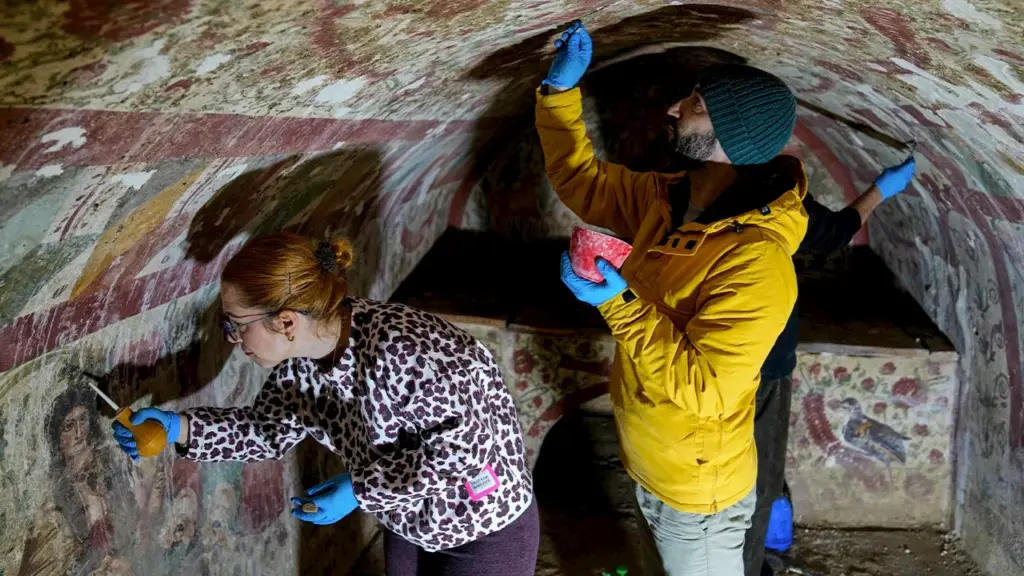
A significant archaeological discovery has emerged from an underground tomb near Iznik, Turkey, where archaeologists uncovered a fresco depicting Jesus as the ‘Good Shepherd’. This artwork, dating back to the third century, is being recognized as a major find from the early Christian period of Anatolia. The discovery coincides with recent events marking the 1,700th anniversary of the Council of Nicaea, which took place in 325 A.D. and established key tenets of Christian belief.
The fresco was found during excavations in a site that has historical significance, as Iznik is known for being the location where the Nicene Creed was formulated, a foundational document for Christian doctrine. The artwork portrays a youthful, clean-shaven Jesus dressed in a toga and cradling a goat on his shoulders, symbolizing the Good Shepherd theme central to early Christian teachings. This representation reflects a blend of Roman artistic styles and Christian iconography, illustrating the interactions between the emerging Christian faith and the dominant Roman culture of the time.
According to the Associated Press, the fresco is one of the few examples in Anatolia where Jesus is depicted with distinctly Roman characteristics. The lead archaeologist involved in the project described the fresco as a unique find, highlighting its potential to offer insights into the religious practices and artistic expressions of early Christians. This discovery is particularly compelling given the historical context of Christian persecution during the Roman Empire, providing a tangible connection to the challenges faced by early followers of the faith.
The unveiling of the fresco gains further significance as it coincides with a visit from Pope Leo XIV. During his trip, the Pope participated in commemorative activities associated with the anniversary of the Council of Nicaea. Turkish President Recep Tayyip Erdoğan presented the Pope with a tile painting of the newly discovered fresco, emphasizing the importance of this archaeological find within the broader narrative of Christian history.
During the visit, Pope Leo XIV was joined by both Eastern and Western Christian leaders in a prayer service at the historic site. Together, they recited the Nicene Creed, which the Pope referred to as a guiding document for Christians seeking unity. The convergence of the Pope’s visit and the fresco discovery underscores the enduring relevance of Iznik as a pivotal location in Christianity’s history.
The preservation of the fresco over the centuries, despite its underground location, attests to the resilience of early Christian communities. This discovery not only enriches our understanding of early Christian art but also highlights the themes of compassion and community care that early Christians emphasized in their practices. The unique portrayal of Jesus as the Good Shepherd reflects the community’s focus on guidance and support, further cementing the fresco’s importance as a historical and cultural artifact.
As scholars and archaeologists continue to study this remarkable find, it opens the door to further exploration of early Christian heritage and its impact on contemporary beliefs. The fresco serves as a reminder of the complex interplay between faith and culture in ancient times, offering valuable insights into the legacy of Christianity in the region.