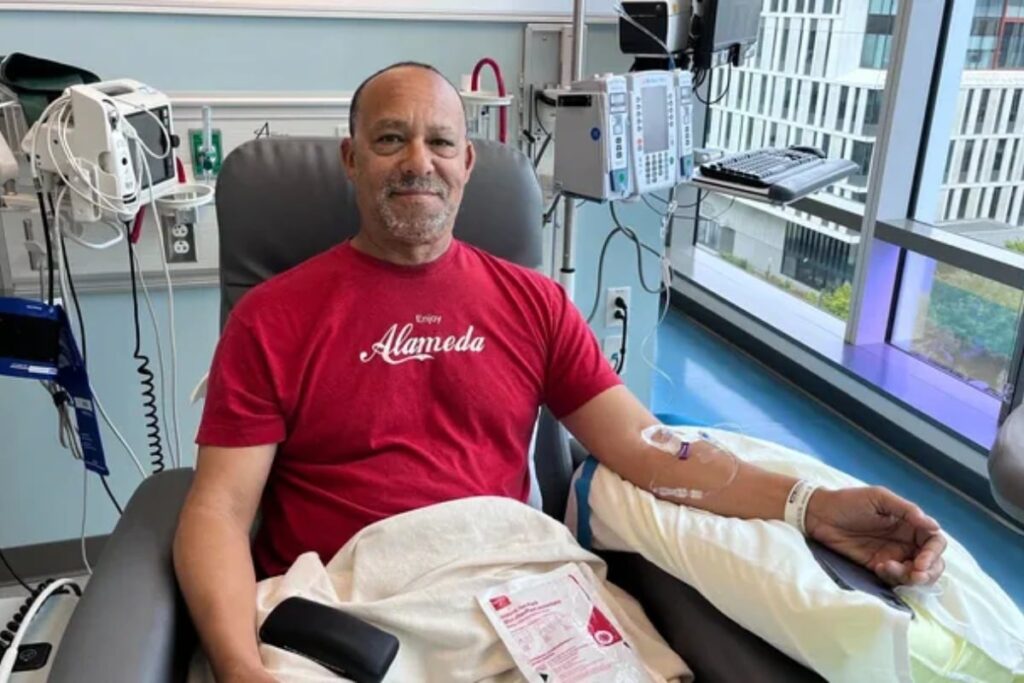
A retired firefighter from San Francisco is facing a critical battle—not only against stage 4 lung cancer but also with his insurance company. Ken Jones, 70, is contesting the denial of coverage for chemotherapy and immunotherapy treatments prescribed by his oncologists at the University of California, San Francisco (UCSF). The treatment denial by Blue Shield of California has left Jones and his family in a dire predicament, forcing them to consider an out-of-pocket payment of approximately $50,000 for potentially life-saving care.
The distressing news arrived last Wednesday, when Jones learned that Blue Shield deemed his prescribed treatment as “outside the standard course of care.” This decision came despite an appeal from his medical team, intensifying the urgency of his situation. His wife, Helen Horvath, expressed the gravity of the denial during a hearing on January 9, stating, “That denial is causing serious harm to Ken’s health and is now threatening his life.”
An Ongoing Issue for Retired Firefighters
Jones’s case is not an isolated incident. Since the city transitioned from UnitedHealthcare to Blue Shield in January 2025, many retired firefighters have reported similar challenges regarding coverage denials. Fred Sanchez, former deputy fire chief and current head of Protect Our Benefits, a nonprofit advocating for city retirees, noted that many elderly retirees often give up after receiving such denials. “Most of the people are retired—60, 80, 90 years old—when they get a denial, they say, ‘Oh, I guess that is, and they give up,'” Sanchez remarked.
In previous instances, the San Francisco government had to intervene with Blue Shield when a contract dispute threatened to cut off access to essential medical services for city employees. This growing concern has raised questions about the effectiveness of the city’s decision to change insurers.
Legal Protections for Firefighters
California law recognizes the increased cancer risk faced by firefighters. Under California Labor Code Section 3212.1, cancer in firefighters is automatically presumed to be work-related. This law acknowledges that exposure to smoke, ash, and carcinogens makes first responders significantly more vulnerable to cancer. According to the Firefighter Cancer Support Network, firefighters have a 9% higher risk of being diagnosed with cancer and a 14% higher risk of dying from it compared to the general population.
Jones was diagnosed with stage 4 adenocarcinoma in March 2025. By the time Blue Shield denied his treatment in January 2026, Dr. Matthew Gubens, his oncologist, had submitted a detailed appeal outlining the necessity of the treatment plan. When Blue Shield refused to reverse its decision, Dr. Gubens expressed his shock at the denial.
At the Health Service Board hearing last Friday, Jones remained silent while his daughter, Rachel, spoke on his behalf, articulating the family’s frustration. “Today I’m forced to stand here and beg because an insurance company decided that profits matter more than the life of a man who spent his career protecting this city,” she stated emotionally.
Support for Jones has been overwhelming, with a community of retired firefighters, including former Fire Chief Jeanine Nicholson, rallying around him. Nicholson, a cancer survivor herself, emphasized the importance of ensuring firefighters do not have to fight for their health care after dedicating their lives to serving the community.
Community Response and Official Accountability
Facing the burden of treatment costs, Jones’s family initiated a GoFundMe campaign with a goal of $50,000. Remarkably, they reached their target over the weekend, showcasing the community’s support but also highlighting the troubling state of the healthcare system that necessitated such fundraising.
In response to the situation, Blue Shield released a statement, declining to comment on the specifics of Jones’s case due to privacy laws. “Blue Shield values our relationship with the City and County of San Francisco. We are committed to working closely with the Health Service Board to address any issues that are raised by members,” a spokesperson stated.
San Francisco Supervisor Matt Dorsey, who is part of the Health Service Board, has pledged to seek accountability from Blue Shield. He stated, “We want to get answers on whether this practice represents a change or something new that is a diminution of service from Blue Shield of California, because that is not what we signed up for.”
While the Health Service Board lacks the authority to reverse claim denials, it does control the city’s health plan contracts, providing it with leverage to influence how the insurer manages medical claims for city employees.
Jones’s situation is emblematic of a broader issue facing firefighters across the United States. A 2023 investigation by Public Health Watch revealed that despite all 50 states having laws presuming certain cancers to be work-related, many cities and counties continue to deny or delay workers’ compensation benefits for firefighters. In Texas, for example, between 29% and 69% of cancer claims for first responders were initially denied even after the state strengthened its presumption laws in 2019.
Reforms in California, including Senate Bill 1127 passed in 2022, aim to improve the handling of presumptive claims but the effectiveness of these laws depends on enforcement.
As San Francisco recently announced a $3.6 million initiative to provide PFAS-free protective gear to its firefighters, the contrast is stark for Jones. Despite having spent 17 years in service before such protective measures were available, he now finds himself in a struggle for necessary treatment against an insurance system that is resistant to change.
As of now, Jones continues his battle against cancer and the challenges posed by an insurance company that has denied him essential support in his time of need.