A recent study from researchers at Kyoto University has identified a brain pathway that may play a critical role in understanding and treating conditions like depression and schizophrenia. The research focuses on a neural circuit that acts as a “motivation brake,” suppressing the internal drive to initiate tasks when faced with unpleasant situations. This discovery could lead to new interventions for individuals struggling with severe motivational deficits.
The study, published on October 2, 2023, in the journal Current Biology, was led by Dr. Ken-ichi Amemori, an associate professor at the Institute for the Advanced Study of Human Biology. The researchers worked with macaque monkeys trained to perform tasks that involved varying degrees of reward and punishment. Their findings reveal insights into the neural mechanisms underlying avolition—a condition where individuals know they need to act but find it challenging to take the first step.
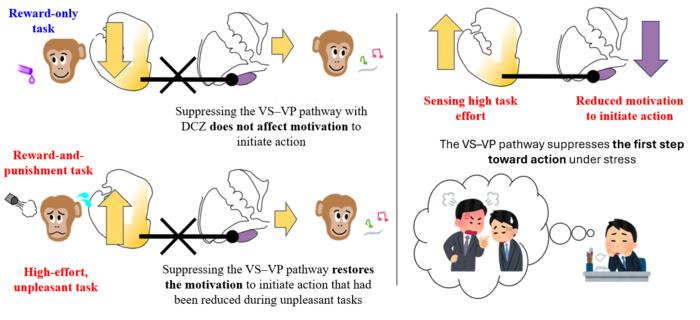
Utilizing a technique called chemogenetics, the research team manipulated the communication between two brain regions: the ventral striatum (VS) and the ventral pallidum (VP). This pathway was identified as crucial in regulating motivation, particularly under aversive conditions. When the VS–VP pathway was suppressed, the monkeys displayed a restored willingness to start tasks that were previously avoided due to the associated stress.
Dr. Amemori explained that motivation is essential for initiating and sustaining goal-directed behavior. Yet, it often diminishes in response to perceived challenges. The study indicates that before taking action, the brain evaluates the required effort. If the perceived cost is too high, motivation falters. Until now, the specific neural mechanisms behind this motivational suppression have remained largely unexplored.
Through their experiments, the team observed that the monkeys had no hesitation when completing tasks solely focused on rewards. However, in a more stressful task coupled with a mild punishment—an air puff to the face—the monkeys hesitated to begin. By temporarily inhibiting the VS–VP pathway, the researchers found a significant increase in the animals’ willingness to initiate action, even when the task was unpleasant.
The implications of these findings are profound. The VS is known for its role in reward processing, while the VP is involved in goal-directed actions. Dysfunction in these regions has been linked to various psychiatric disorders, including major depressive disorder (MDD) and schizophrenia. Dr. Amemori and his team argue that understanding the VS–VP pathway could pave the way for novel treatment strategies aimed at restoring motivation.
The researchers also highlighted that while a tight motivational brake can lead to avolition, an overly loose brake could result in impulsive behavior or burnout. Therefore, finding an appropriate balance in motivation is crucial. Future interventions could include techniques such as deep brain stimulation or novel pharmacological strategies to fine-tune this pathway.
The study underscores the need for a broader societal dialogue on motivation, particularly as burnout becomes increasingly prevalent. It suggests that rather than solely focusing on boosting individual willpower, there should be greater emphasis on how society can support individuals in managing stress and enhancing motivation.
In conclusion, the identification of the VS–VP pathway as a key regulator of motivation under stress presents new avenues for addressing motivational deficits in psychiatric disorders. Researchers are optimistic that these insights will contribute to advancements in treatment, ultimately improving the quality of life for individuals facing challenges related to avolition and motivation.