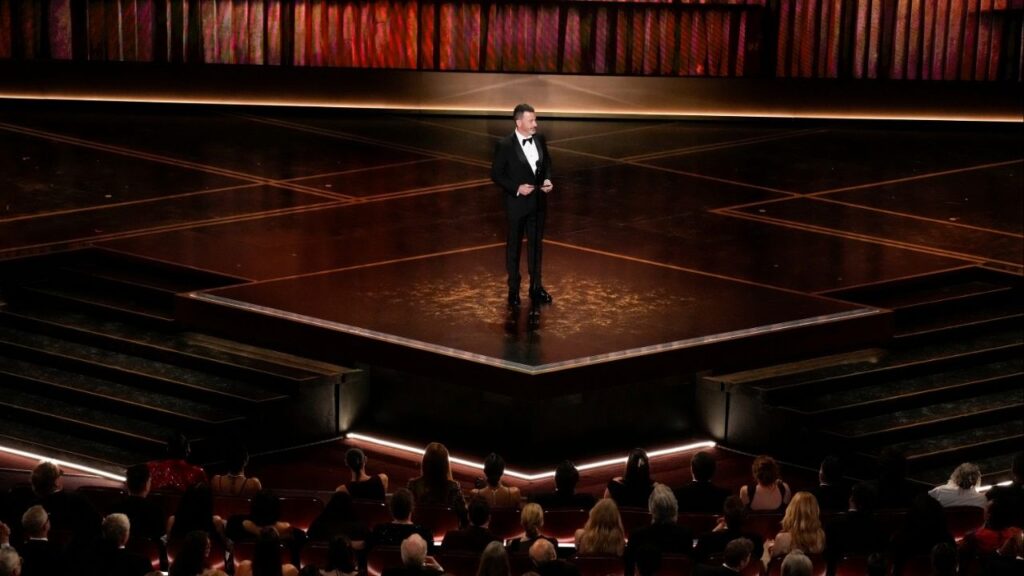
During the Oscars ceremony held in Los Angeles, discussions about free speech and global conflicts took center stage, underscored by pointed remarks from various presenters and winners. Notably, comedian Jimmy Kimmel, who was not hosting the event, delivered a striking commentary on the courage required to tell stories that could endanger lives.
Remarks on Courage and Complicity
In his introduction of the films nominated in the documentary categories, Kimmel remarked, “We hear a lot about courage at shows like this, but telling a story that could get you killed for telling it is real courage.” He also referenced countries with limited support for free speech, hinting at North Korea while subtly addressing the political climate surrounding CBS, which is currently involved in a significant merger with Warner Bros.
Conan O’Brien, the ceremony’s host, followed suit in his opening monologue by acknowledging the chaotic state of global affairs. He stated, “We are all too aware that these are very chaotic, frightening times,” setting a tone that resonated throughout the evening.
Several winners utilized their platform to address pressing global issues. David Borenstein, co-director of the documentary “Mr. Nobody Against Putin,” emphasized the impact of complicity in governmental actions. While accepting the Oscar, he articulated, “When we act complicit, when a government murders people on the streets of our major cities, when we don’t say anything… we all face a moral choice.”
Calls for Peace and Justice
The documentary featured Pavel Talankin, a primary schoolteacher and co-director, who delivered a poignant message through an interpreter. He urged, “In the name of our future, in the name of all of our children, stop all of these wars now,” directly appealing to the audience to take action against conflict.
Later in the evening, Javier Bardem, presenting the award for best international film, made a bold statement, declaring, “No to war — and free Palestine.” His remarks encapsulated the sentiments expressed throughout the night, as many participants sought to highlight the intersection of art, politics, and social justice.
The Oscars thus served not only as a celebration of cinematic achievements but also as a platform for urgent discussions on free speech and the global conflicts affecting millions. The impactful statements made during the event resonate with an audience increasingly aware of the struggles faced by those who dare to speak out against oppression.