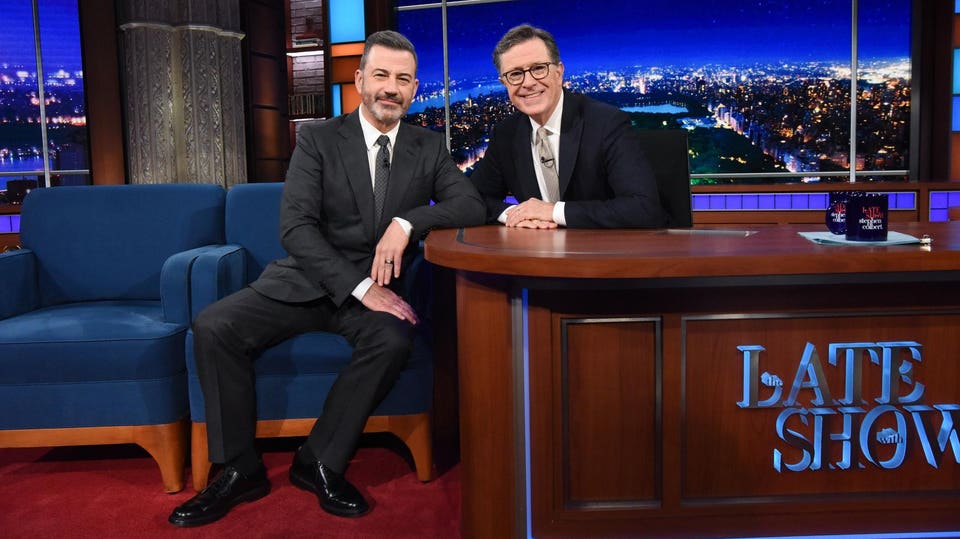
Late-night talk show hosts Jimmy Kimmel and Stephen Colbert have expressed strong opposition to the Federal Communications Commission (FCC) enforcement of its “equal time” rule, which mandates that broadcasters provide equal airtime to opposing political candidates. This development has been characterized by Kimmel as a “crackdown” aimed at stifling the creative freedom of their shows. The hosts voiced their concerns during their respective monologues on Thursday night, highlighting the potential implications for political discourse in late-night television.
Hosts Speak Out Against FCC Measures
Kimmel initially addressed the FCC’s directive in his Wednesday monologue, drawing attention to what he termed a “war on talk shows” led by former President Donald Trump. He referenced a post from Trump on Truth Social, claiming that the FCC was making it increasingly difficult to conduct interviews with politicians. In his Thursday night segment, Kimmel elaborated on these points, criticizing FCC Chair Brendan Carr for “reinterpreting long-agreed-upon rules to stifle us.”
The late-night host explained that the “equal time” requirement was established when radio was the dominant medium and later extended to television. Kimmel highlighted that since 2006, late-night shows have operated under a news exemption, a precedent set when then-California Governor Arnold Schwarzenegger appeared on “The Tonight Show.” He emphasized that this exemption had allowed for a broader range of viewpoints, and he accused Carr of attempting to silence dissenting opinions.
Kimmel further noted the declining relevance of broadcast television, stating that it has dropped from accounting for 100% of viewership to just about 20%. He pointed out that networks like Fox News and One America News Network currently dominate the landscape with extensive pro-Trump programming. “I have no idea what the outcome of this is going to be,” Kimmel remarked, indicating uncertainty about the future of political commentary in late-night television.
Colbert’s Take on the New Crackdown
Colbert addressed the FCC’s actions later in his Thursday show, commenting on the impact these rules could have on his own programming. He humorously warned his audience, “I got to watch what I say about Trump,” as he read a New York Times headline that characterized the FCC’s move as a “new crackdown on late-night TV.” This prompted boos from the audience, reflecting their discontent with the situation.
Colbert also shared that he had been advised by his lawyer to be cautious about discussing the new rules. He described the FCC’s efforts as a clear attempt to silence him, Kimmel, and fellow host Seth Meyers. In a light-hearted but pointed moment, he addressed the FCC directly, saying, “Hey, I’m flattered you think that appearing on my show has the power to affect politics in any way.”
This ongoing tension between late-night hosts and regulatory bodies raises significant questions about the future of political commentary in television, especially as the landscape of media consumption continues to evolve. The FCC’s decision to enforce the “equal time” rule has been met with skepticism regarding its relevance in today’s media environment, where traditional broadcast television faces stiff competition from streaming services and digital platforms.
As Kimmel and Colbert navigate these challenges, their responses reflect a broader concern among comedians and entertainers about the limits of free expression and the potential impact of regulatory measures on public discourse. The situation warrants close attention as it unfolds, particularly given its implications for how political figures engage with the media.