Fallout Season 2 Episode 6, titled “The Other Player,” delivers intriguing developments and character dynamics as it approaches the season’s climax. This episode significantly expands on the existing factions within its post-apocalyptic world, raising questions about loyalty and morality.
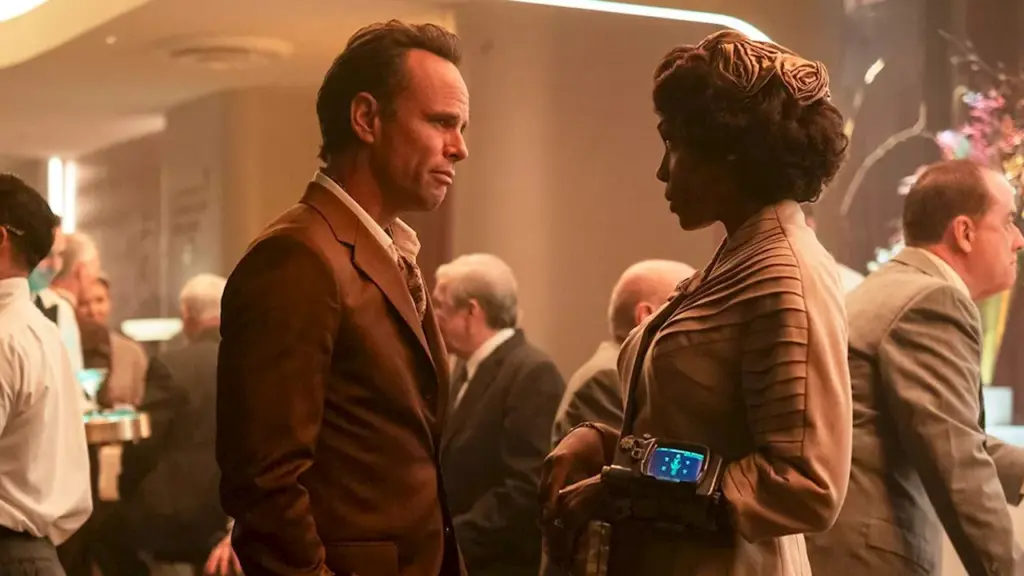
The narrative opens with Barb, portrayed by Frances Turner, attending a presentation at Vault-Tec on nuclear bombs and the looming threat of the world’s end. The presentations touch on various topics, including water scarcity in Vaults and premium highway access for customers seeking refuge. Following the presentations, Barb meets with a character named Robert House, played by Walton Goggins, who presents her with a device called the “automated man.” This device, which appears to be a twisted form of mind-control technology, hints at the sinister underpinnings of Vault-Tec’s plans.
As the episode unfolds, Barb’s emotional state is revealed as she reflects on her family, questioning the choices that have led her to this point. The weight of her decisions becomes increasingly significant as the story progresses.
Meanwhile, in New Vegas, the Ghoul, formerly known as Cooper Howard, finds himself in dire straits. Impaled and losing hope, he clings to memories of his daughter as he battles the physical and psychological toll of his situation. Desperation drives him to pull himself up the pole that has trapped him, but he ultimately fails, suffering further injury.
Unexpectedly, a supermutant rescues the Ghoul, introducing a new layer to the story. This creature, who refers to the Ghoul as kin, offers to help him heal with uranium. This moment not only illustrates the potential for alliances in a world torn apart by conflict but also sets the stage for future battles against the Enclave. The Ghoul’s refusal to accept help reinforces his desire to find his family alone, hinting at deeper motivations that will likely unfold in subsequent episodes.
The episode also revisits the complex relationship between Cooper and Barb through flashbacks. Their intense discussions reveal conflicting ideals about morality and sacrifice in the name of family. Barb’s determination to protect their daughter, Janey, raises ethical questions about the extent one should go to ensure the safety of loved ones. The flashbacks effectively juxtapose their past with present choices, illustrating how deeply ingrained their motivations have become.
The narrative shifts to Lucy, who awakens in a recreated version of her home from the Vault. As she explores, she discovers disturbing truths about her father, Hank MacLean. The episode artfully depicts Lucy’s struggle between justice and the acknowledgment of the darker realities of their world. Her confrontation with Hank, where he surrenders himself, underscores the moral complexities that define their relationship.
As Lucy and Hank navigate the evolved landscape of Vault-Tec’s operations, the episode highlights the chilling reality of mind-control technology and its impact on individuals. Lucy’s determination to bring Hank to justice contrasts sharply with Hank’s insistence that he acted to protect her, reflecting the intricate web of relationships within the series.
In Vault 33, a social gathering known as the Inbreeding Support Group continues to attract attention despite challenges from Overseer Betty Pearson. The dynamics within the group provide a glimpse into the community’s struggles, marked by both camaraderie and the harsh realities of their existence. Reg, a prominent character, embodies the spirit of resilience, illustrating how individuals cope with adversity in a world ravaged by crisis.
The episode culminates with Maximus and Thaddeus, who reconnect after a period of separation. Their dialogue reveals differing philosophies about the future and morality within the chaotic landscape of the Wasteland. As they encounter Dogmeat, who leads them to the Ghoul, the potential for new alliances emerges, setting the stage for dramatic confrontations and decisions in upcoming episodes.
“The Other Player” effectively deepens the narrative while maintaining the tension and intrigue that has characterized Fallout Season 2. As characters grapple with their choices and the implications of their alliances, viewers are left with compelling questions about trust and the true nature of good and evil in a world stripped of certainty. With the season drawing to a close, the stakes have never been higher for the characters, promising an exciting conclusion to their journeys.