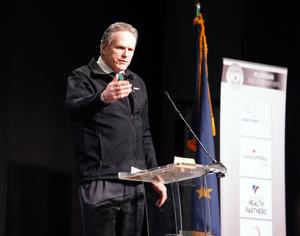
Alaska Governor Mike Dunleavy provided insights into the state’s fiscal strategy during an address to the Greater Fairbanks Chamber of Commerce on March 26, 2024. His discussion occurred in the context of heightened geopolitical tensions following a military conflict initiated by the United States and Israel against Iran over the previous weekend. The conflict has already resulted in Iranian retaliatory actions against several Middle Eastern nations, including Qatar, Kuwait, and Saudi Arabia, leading to significant disruptions in global oil and natural gas supplies.
Dunleavy emphasized the immediate economic implications of these events, predicting increased oil prices as a result of ongoing hostilities. “It’s going to be higher prices for oil,” he stated, acknowledging the uncertainty regarding the war’s outcome. Despite the challenges, he noted a potential advantage for Alaska, which could be seen as a stable energy source attractive for investment, particularly with projects related to North Slope oil and the proposed Alaska LNG natural gas pipeline.
The governor pointed out that oil futures surged following the recent attacks, which may enhance Alaska’s revenue in the short term. Nevertheless, he cautioned against relying solely on fluctuating oil prices. “Short term, the price of oil goes up, and it kind of saves the [Alaska] Legislature and state government,” Dunleavy remarked, adding that this approach may not be sustainable in the long run.
Long-Term Fiscal Plan Introduced
In light of ongoing fiscal challenges, Dunleavy introduced a comprehensive long-term fiscal plan aimed at stabilizing Alaska’s economy. This proposal includes several key components: implementing spending limits, legally enshrining 50% of the Permanent Fund dividend, introducing a seasonal sales tax, revising the oil production tax from 4% to 5%, and instituting a 15-cent fee per barrel of oil. Notably, the sales tax would be phased out by 2034, while changes to the oil tax would conclude in 2031. His plan also seeks to eliminate the state’s corporate income tax by 2031.
Dunleavy expressed concern over the state government’s reliance on uncertain oil revenue forecasts, which no longer represent the primary source of income for Alaska. He highlighted the example of Texas, where the majority of revenue is derived from sales tax rather than oil production taxes. According to the Texas Comptroller’s office, sales tax contributed 58% of the state’s revenue, amounting to $4.3 billion in December 2023, while oil and gas taxes generated $8 billion overall.
“I want to leave the next governor in a better shape than I was,” Dunleavy said, reflecting on the fiscal challenges faced by his predecessors, including former Governor Bill Walker. He warned that without a cohesive fiscal plan, ongoing disputes over budget allocations could distract from more pressing issues, such as education reform and affordable energy.
Challenges and Opportunities with Alaska LNG
Dunleavy also highlighted the Alaska LNG project as a potential economic boon for the state. He noted that the project’s majority owner, Glenfarne Group, has made significant progress in securing non-binding agreements. “Just like the trans-Alaska oil line, the gas line will be transformational for the state,” he asserted, stating that it could generate jobs, stimulate the economy, and reduce energy costs for Alaskans.
However, the project faces several hurdles, including the need for a workforce of at least 7,000 workers amidst current housing and budget constraints. Additionally, Dunleavy plans to propose legislation that would offer the Alaska LNG project up to a 90% tax break, which he hopes will alleviate financial pressures.
Local leaders have expressed concerns about the project’s impact on their communities. The mayor of Fairbanks North Star Borough, Grier Hopkins, indicated that the borough’s primary interest lies in ensuring that residents have access to affordable energy, specifically through a spur line to Fairbanks. “We don’t need more gas, we need more affordable gas,” Hopkins stated, underscoring the importance of keeping construction costs manageable for local residents.
Dunleavy echoed this sentiment, stating, “It’s pointless to want a gas line in which Fairbanks is not part of that mix.” He aims to ensure that the construction of the spur line occurs without imposing additional tariffs on ratepayers.
As Alaska navigates these complex economic dynamics, the governor’s fiscal plan and the Alaska LNG project could play pivotal roles in shaping the state’s future amidst a volatile energy landscape.