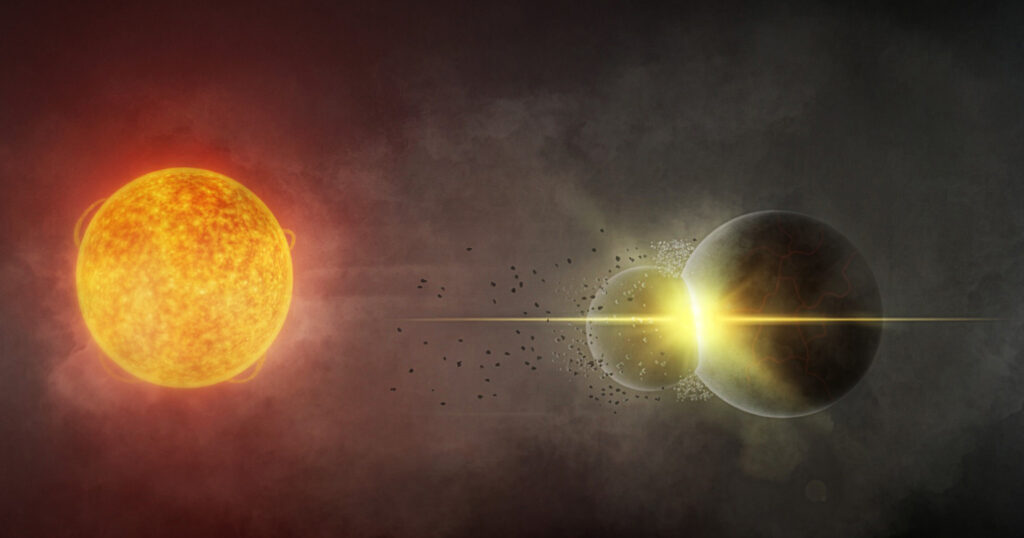
Astronomers have recently identified signs of a catastrophic collision between two distant planets, offering new insights into planetary formation and the evolution of our solar system. This groundbreaking study, published in The Astrophysical Journal Letters, indicates that the collision could shed light on the origins of the Moon and the dynamics surrounding such cosmic events.
The investigation centered on a main sequence star referred to as Gaia20ehk. Initially, the star appeared to burn steadily, similar to our Sun, until fluctuations in brightness began to emerge around 2016. By 2021, these fluctuations intensified dramatically. Lead author Anastasios Tzanidakis, an astronomer from the University of Washington, noted, “The star’s light output was nice and flat, but starting in 2016 it had these three dips in brightness. And then, right around 2021, it went completely bonkers.”
Upon further investigation, astronomers concluded that the irregularities in brightness were not linked to the star itself but rather to massive streams of rock and dust passing in front of it. The quantities of debris involved were significant enough to impact the star’s light, leading the researchers to hypothesize that they originated from a planetary collision.
Insights from Observations
Additional observations using another telescope confirmed this theory. The infrared data revealed spikes in light intensity, suggesting that the blocking material was extremely hot, potentially emitting infrared light due to the immense heat produced by the collision. Tzanidakis explained, “That could be caused by the two planets spiraling closer to each other. At first, they had a series of grazing impacts, which wouldn’t produce a lot of infrared energy. Then, they had their big catastrophic collision, and the infrared really ramped up.”
The significance of these findings lies in their rarity. Tzanidakis expressed excitement over the fact that various telescopes captured this impact in real time. He emphasized, “There are only a few other planetary collisions of any kind on record, and none that bear so many similarities to the impact that created the Earth and Moon.”
The implications extend beyond this specific case. The observed collision parallels an ancient event believed to have occurred about 4.5 billion years ago, when a hypothetical planet named Theia, estimated to be the size of Mars, collided with Earth. This cataclysm is thought to have resulted in the formation of the Moon from the debris of the impact.
Potential Implications for Astrobiology
Interestingly, the dust cloud surrounding Gaia20ehk orbits at a distance comparable to the Earth’s distance from the Sun, or one astronomical unit. This positioning raises the possibility that similar collisions could lead to the formation of rocky satellites around distant stars, potentially influencing the search for extraterrestrial life.
Tzanidakis pointed out that our Moon’s size relative to Earth plays a crucial role in creating conditions conducive to life. He stated, “Our Moon is unusually large compared to its host planet, and it seems to be one of the magical ingredients that makes the Earth a good place for life.” The Moon helps shield Earth from asteroids, influences tides, and impacts weather patterns.
The rarity of collisions that could lead to the formation of large moons suggests that the conditions necessary for life may also be uncommon. Tzanidakis remarked, “Right now, we don’t know how common these dynamics are. But if we catch more of these collisions, we’ll start to figure it out.”
As scientists continue to monitor the cosmos, this study serves as a reminder of the dynamic and often violent nature of planetary formation, as well as its implications for our understanding of the universe.