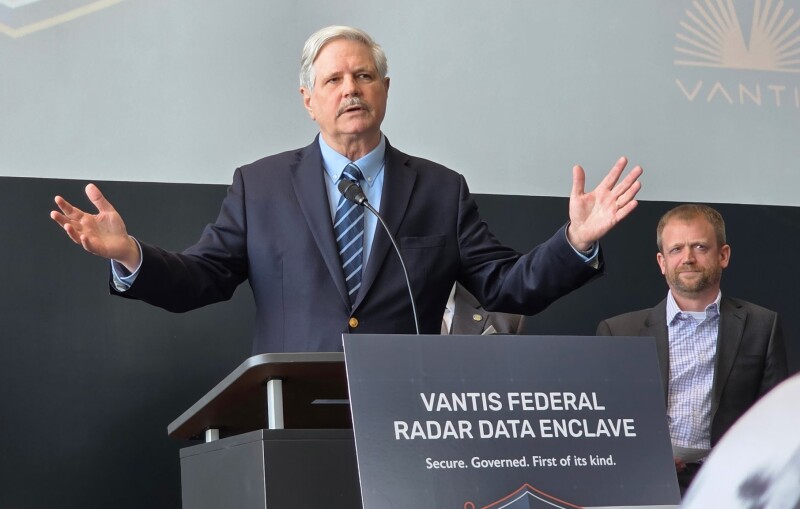
North Dakota has officially activated the Vantis Federal Radar Data Enclave, a significant advancement in the unmanned aerial systems (UAS) sector. Announced by Senator John Hoeven during a press conference at the University of North Dakota on February 27, 2024, this initiative is expected to solidify the state’s position as a leader in UAS technology.
Senator Hoeven emphasized the enclave’s potential, stating, “It puts us ahead of anyone else in the country in a big way.” He noted that catching up to North Dakota’s advancements will require considerable effort from other regions. The Vantis system integrates unfiltered radar data from the Federal Aviation Administration (FAA) with the existing infrastructure at the Northern Plains UAS Test Site.
Significance of the Radar Data Enclave
This initiative marks a milestone as Northern Plains becomes the first non-federal entity in the United States to access the FAA’s unfiltered radar data feed. The activation follows the inclusion of a provision in the FAA reauthorization bill passed in 2024, which mandates the evaluation of radar data feeds for integrating UAS into the national airspace.
Since the announcement of the partnership between the FAA and Northern Plains, the test site has been diligently working to implement the necessary systems and technology to utilize this data effectively. “That’s why it’s taken us almost two years to set it up,” Hoeven explained.
Hoeven highlighted three key competitive advantages that the enclave will provide North Dakota in the UAS landscape. Firstly, it will facilitate statewide operations of beyond-visual-line-of-sight (BVLOS) UAS flights, increasing the frequency of such flights across the state. Secondly, the enclave will enhance national security by addressing counter-drone challenges. The Point Defense Battle Lab at Grand Forks Air Force Base and the Technology Readiness Experimentation program (T-REX) at Camp Grafton will utilize these capabilities for military applications, with the Camp Grafton program set to commence in August 2024.
Future Opportunities and Economic Impact
North Dakota is poised to become a testing ground for counter-drone technology, particularly relevant for significant events such as the upcoming 2026 World Cup and celebrations for America’s 250th anniversary. The enclave’s establishment will not only bolster military operations but also stimulate economic growth by creating new opportunities for UAS research and development.
Senator Hoeven asserted that the enclave will allow drones to operate in national airspace for both military and civilian purposes, supporting a variety of flight scenarios. This initiative will benefit companies of all sizes, providing essential support for emerging businesses and military operations alike. “It helps the military find solutions and it helps these young companies get going,” he stated.
With the activation of the Vantis Federal Radar Data Enclave, North Dakota aims to set a new standard for UAS technology and operations, reinforcing its status as a pioneering state in the field.