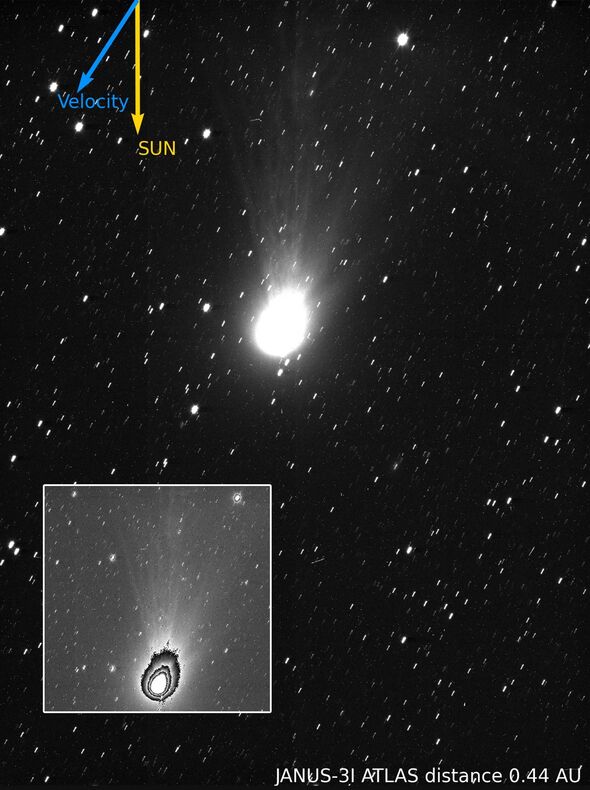
Space scientists have unveiled new images of the interstellar Comet 3I/ATLAS, which is currently expelling gas and dust as it traverses the solar system. Captured by the JANUS camera on the European Space Agency’s (ESA) Jupiter Icy Moons Explorer (Juice) spacecraft, the photograph offers a detailed view of the comet’s activity. This observation adds to ongoing discussions regarding the comet’s nature, with some researchers, including Harvard astrophysicist Avi Loeb, suggesting it could be more than just a typical space rock.
The image, taken on November 6, 2025, shows a bright halo of gas known as the coma surrounding the comet’s nucleus, which remains invisible. The ESA noted, “A long tail stretches away from the comet, and we see hints of rays, jets, streams, and filaments.” At the time the image was captured, Juice was approximately 66 million km from the comet, allowing for a unique perspective on its emissions. In total, the JANUS camera has taken over 120 images of Comet 3I/ATLAS across various wavelengths, which researchers are now analyzing for further insights.
Earlier this month, a separate study documented a significant increase in the comet’s brightness two months after its closest approach to the Sun. The peculiar brightness and trajectory of Comet 3I/ATLAS have led to speculation about its origin. Professor Loeb, who first identified the comet in July 2025, has suggested that it may be an artificial probe sent by an advanced alien civilization. He pointed to the object’s unusual glow and its alignment with planetary orbits as evidence worth investigating.
Among the characteristics that intrigue scientists are the comet’s retrograde orbit, which aligns closely with the ecliptic plane. Loeb estimates the probability of such an alignment occurring naturally is less than 0.2%. Furthermore, the comet’s path is set to approach Mars, Venus, and Jupiter, raising questions about its source and trajectory.
One of the most striking features is the presence of an “anti-tail,” which instead of the typical cometary tail extending away from the Sun, shows a jet directed toward it, extending over 310,000 miles. Chemical analysis of the comet’s gas plume has revealed a high abundance of nickel and a low presence of iron, suggesting it resembles industrial alloys more than natural comets. Additionally, with only 4% water content, this is notably low for a comet, leading to further inquiries about its composition.
Despite Loeb’s assertions, the broader scientific community remains skeptical. NASA, ESA, and other institutions continue to classify Comet 3I/ATLAS as a natural comet, albeit with some unusual attributes. The ongoing debate highlights the challenges of distinguishing between natural cosmic phenomena and potential technological artifacts in the vastness of space.
As scientists delve deeper into the findings from the JANUS camera, the implications of Comet 3I/ATLAS will continue to unfold. Whether it is a natural occurrence or something more complex, the observations promise to enhance our understanding of interstellar objects and their behaviors in our solar system.