Cinzia DaVià, a professor of physics at the University of Manchester and a research professor at Stony Brook University, has dedicated her career to harnessing collaboration to drive scientific innovation. Her work spans from developing silicon sensors for CERN’s particle accelerator experiments to exploring solutions for portable energy generation. DaVià emphasizes that teamwork is essential for overcoming complex challenges in physics, healthcare, and environmental sustainability.
From Italy to Global Impact
Born in the Italian Dolomites, DaVià’s fascination with science ignited during childhood after watching a documentary series on astrophysics. This passion led her to enroll at the University of Bologna, where she pursued a degree in astronomy and astrophysics. A pivotal summer internship at CERN in Geneva shifted her focus towards radiation instrumentation, setting the stage for a remarkable career.
During her decade-long tenure at CERN from 1989 to 1999, DaVià contributed to significant discoveries, including advancements in radiation hardness of silicon sensors at cryogenic temperatures, known in physics as the Lazarus effect. These sensors are critical in collider experiments, capturing the initial moments of particle creation. Her research led to the development of a method to revive nonfunctional detectors by cooling them to temperatures below -143° C.
One of her notable achievements was collaborating with inventor Sherwood Parker to create 3D silicon sensors that withstand extreme radiation. This innovation allowed scientists to replace traditional planar sensors in the most exposed areas of collider detectors, marking a substantial leap forward in particle physics research.
Commitment to Sustainable Solutions
DaVià’s dedication to collaboration extends beyond particle physics. She is deeply concerned about the effects of extreme weather events, particularly on vulnerable communities. This commitment intensified after attending the American Institute of Architects International symposium, where discussions focused on mitigating disaster impacts.
Inspired by initiatives like IEEE’s MOVE program, which provides power and communication during natural disasters, DaVià is leading efforts to develop “smart shelters.” These portable structures aim to assist recovery in remote areas by providing essential resources during emergencies. She is organizing a two-day conference at CERN in October 2024 to foster sustainable entrepreneurship and encourage innovative solutions for energy generation and storage.
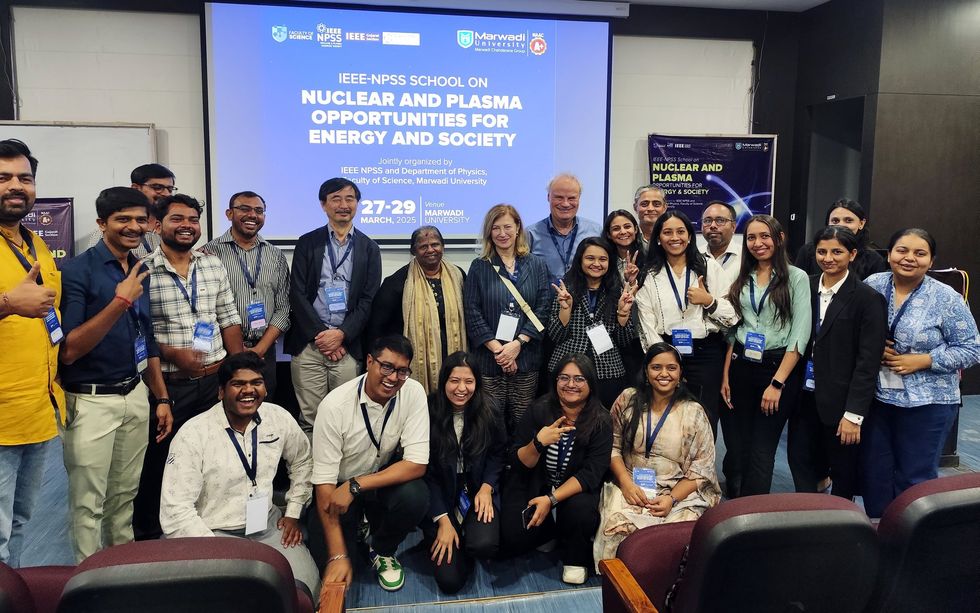
DaVià also plays a key role in the IEEE Online Forum on Climate Change Technologies and has spearheaded the Climate Change Initiative within the IEEE Nuclear and Plasma Sciences Society. Her efforts have led to securing funding for climate-related workshops, including the 2024 Climate Workshop on nuclear and plasma solutions for energy and society.
As DaVià balances her roles at the University of Manchester and Stony Brook University, she remains active at CERN, mentoring students in particle physics. Her influence extends to various initiatives, including serving as a cochair for the European Union’s ATTRACT initiative, promoting radiation imaging research.
With over 900 publications to her name, DaVià is not only a leading figure in her field but also a champion of collaboration across disciplines. She credits IEEE for facilitating her professional connections and emphasizes the importance of collective efforts in addressing global challenges.
“IEEE helps bring people together who might not otherwise connect,” she states, underscoring her belief that unity is crucial for scientific advancement and societal progress.