Astronomers have discovered a rocky planet located in an unexpected position within its solar system, challenging long-established theories of planet formation. This significant finding, reported on February 14, 2026, involves the star system surrounding the red dwarf star LHS 1903, which defies conventional expectations of planetary arrangement.
Typically, researchers observe a pattern where small, rocky planets orbit close to their star, while larger gas giants reside at greater distances. This arrangement is evident in our own Solar System, where the inner planets—Mercury, Venus, Earth, and Mars—are rocky, and outer planets like Jupiter and Saturn are gas-rich. The prevailing theory suggests that intense radiation from young stars strips gases from nearby developing planets, leaving behind solid, rocky worlds closer to the star.
A Surprising Discovery Around LHS 1903
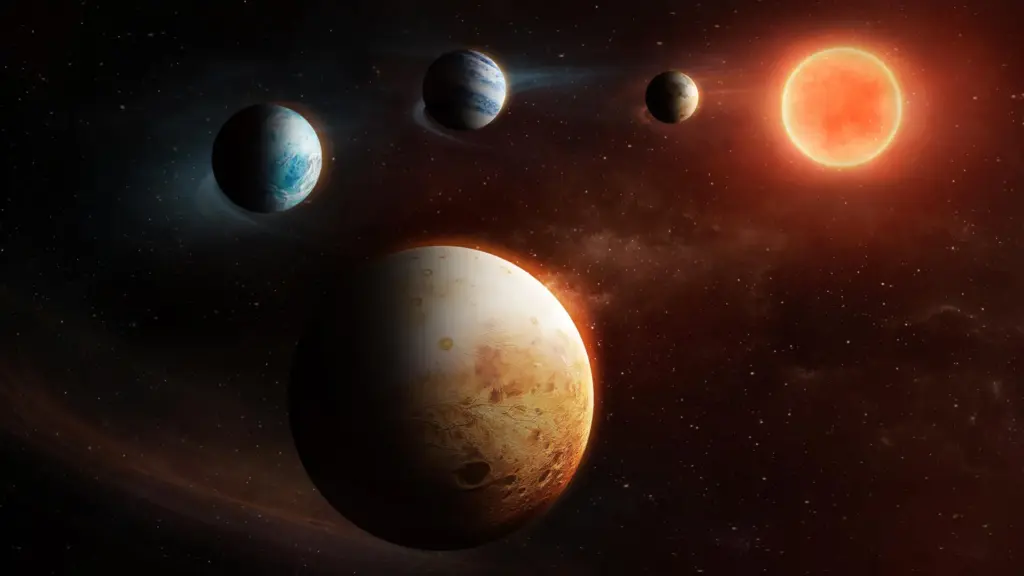
The newly identified system around LHS 1903 challenges this narrative. Researchers from McMaster University, led by Prof. Ryan Cloutier, and Prof. Thomas Wilson from the University of Warwick, utilized data from both terrestrial and space-based telescopes to analyze the system. Initially, they identified three planets: the innermost planet is rocky, followed by two smaller gas giants reminiscent of Neptune. This structure initially aligned with expected outcomes.
However, further observations, particularly from the European Space Agency’s CHEOPS satellite, identified a fourth planet—designated LHS 1903 e—which orbits the star at the greatest distance. Unexpectedly, this outer planet is also rocky, prompting researchers to reconsider their understanding of planetary formation.
“We’ve seen this pattern: rocky inside, gaseous outside, across hundreds of planetary systems. But now, the discovery of a rocky planet in the outer part of a system forces us to rethink the timing and conditions under which rocky planets can form,” said Cloutier.
Revising Planet Formation Models
The research team explored various explanations for the unusual characteristics of LHS 1903 e. They examined whether a significant collision might have stripped away the planet’s atmosphere, as well as the possibility of planetary migration over time. Through extensive computer simulations and analysis of the planets’ orbits, they dismissed these theories.
Instead, the findings suggest that the planets in this system may not have formed simultaneously. Rather, they could have developed sequentially as environmental conditions around LHS 1903 evolved. This concept aligns with a hypothesis known as inside-out planet formation, where planets form in sequence under varying conditions that determine their composition.
In this scenario, when LHS 1903 e began forming, much of the surrounding gas may have already dissipated, leaving insufficient material to generate a thick atmosphere. Cloutier remarked, “It’s remarkable to see a rocky world forming in an environment that shouldn’t favour that outcome. It challenges the assumptions built into our current models.”
This discovery raises broader questions about whether the LHS 1903 system is a unique case or part of a larger, unrecognized pattern in planetary formation. As advancements in telescope technology and detection methods continue, researchers are enhancing their ability to identify planetary systems that differ significantly from our own, expanding the understanding of planetary diversity across the galaxy.
Each new finding contributes to a growing body of evidence that may prompt a reevaluation of the processes that shape worlds throughout the universe.