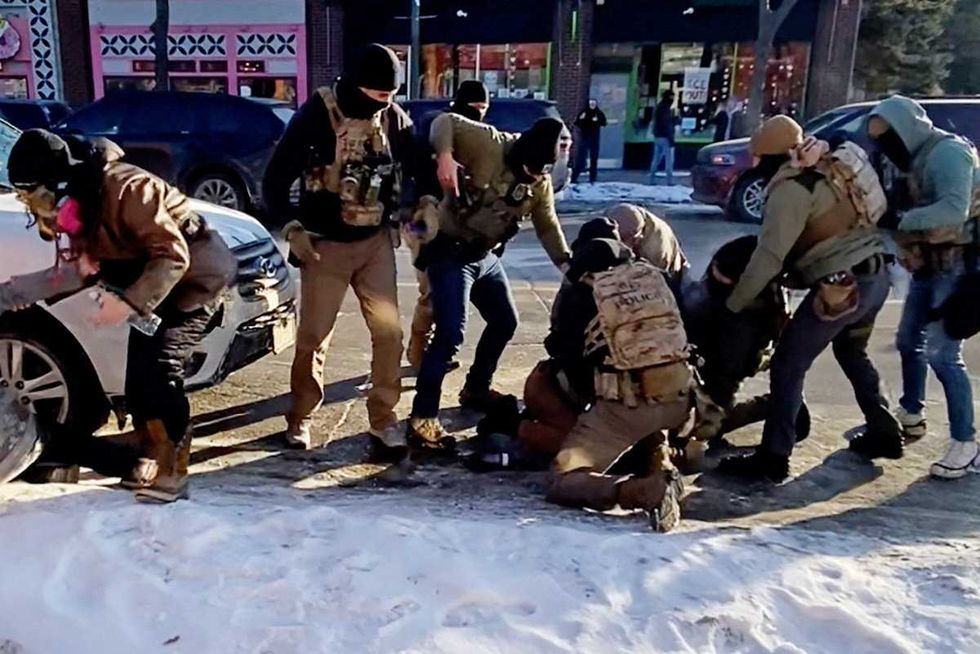
The recent death of Alex Pretti, an ICU nurse, at the hands of U.S. Border Patrol officers has ignited a complex discussion surrounding race, loyalty, and power dynamics in America. The officers involved, identified as Jesus Ochoa, 43, and Raymundo Gutierrez, 35, are of Hispanic descent, which raises questions about their roles in a paramilitary organization that many believe targets Hispanic communities.
This situation has sparked confusion among those grappling with the implications of their actions. Critics of former President Donald Trump argue that the U.S. Immigration and Customs Enforcement (ICE) and Customs and Border Protection (CBP) are engaged in a systematic effort to purge Latino individuals as part of a broader agenda to reshape America’s demographic landscape. Advocates for the Trump administration counter that the actions of Ochoa and Gutierrez demonstrate that the so-called crackdown is not racially motivated, citing their participation as evidence.
The discourse surrounding this incident also touches on deeper societal issues, particularly the complex relationship between race and power in the United States. The idea that whiteness equates to power rather than simply race emphasizes a systemic inequality wherein affluent white individuals are afforded the greatest protections and benefits. This hierarchy leaves marginalized communities, especially those identified as Black or brown, at a significant disadvantage.
Some Hispanic individuals, striving for acceptance within this power structure, may find themselves aligning with oppressive systems. Ochoa and Gutierrez’s employment with CBP exemplifies this phenomenon, as they are perceived as seeking validation from a system that historically marginalizes their own ethnic group. This dynamic is reminiscent of historical examples, such as Irish officers in 19th-century New York, who resorted to violence against their own to demonstrate loyalty to a perceived dominant culture.
Pretti’s involvement in advocating for marginalized individuals puts him at odds with the prevailing logic of white supremacy, which prioritizes allegiance to race over country. In this regard, his actions, which some may view as patriotic, are labeled as treachery by figures like white supremacist Nick Fuentes. Fuentes, who is of Hispanic lineage himself, underscores the paradox of identity and loyalty in the context of race-based power dynamics.
The implications of these events extend beyond individual actions; they reflect a broader societal struggle. Polls indicate that support for Trump among Hispanic voters has diminished significantly since his administration intensified enforcement actions against immigrants. The rhetoric surrounding illegal immigration has increasingly framed non-white individuals as inherently illegal, regardless of legal status, further entrenching racial divides.
The tragic deaths of Pretti and others illustrate a stark reality: the pursuit of acceptance within white power structures often comes at the cost of one’s own community. This pursuit reveals a fundamental truth: no matter the efforts made by individuals like Ochoa and Gutierrez, their acceptance remains conditional and fraught with challenges.
In a recent interview, JD Vance, the Vice President, was asked if he would apologize to Pretti’s family after investigations into his death. Vance’s response, “For what?” highlights the disconnect and lack of accountability that continues to permeate discussions on race and justice in America.
As society grapples with these complex issues, the pressure to confront uncomfortable truths about race and power grows. Respectable white individuals, often reluctant to engage in discussions about race, may find their status increasingly at odds with their values. The ramifications of these conflicts pose significant questions about the future of race relations in America and the potential for a more equitable society.