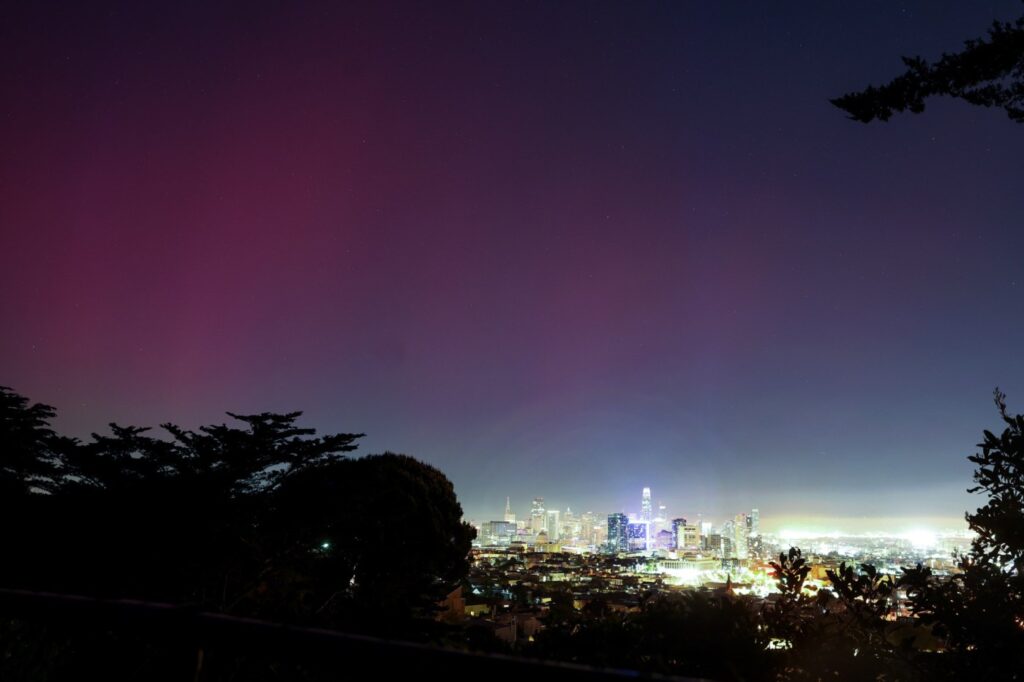
Jason Press, a graduate of Marin Catholic High School, is pioneering the use of artificial intelligence to enhance data collection on the aurora borealis. This innovative approach is being developed as part of a research project at Pepperdine University in Malibu, California. Press aims to improve the accuracy of scientific data regarding this stunning natural phenomenon, which is often obscured by clouds.
At just 22 years old, Press has taken on a significant challenge: the inconsistency of clear skies needed for reliable aurora observations. “There are very few clear-sky nights with aurora data,” he stated in an email. “When clouds roll in, that data is usually lost. My job was to build a model that could see through the clouds.” His efforts have already shown promise, recovering previously unusable scientific data.
Successful Data Recovery and Recognition
Press and his research team achieved notable success last summer, successfully clarifying images from 90 minutes of satellite video of the aurora borealis. By December, their findings garnered enough attention to secure an invitation to present at the American Geophysical Union conference, a prestigious event for scientists in the field.
Fabien Scalzo, Press’ computer science professor, expressed pride in his student’s accomplishments. “I’m thrilled by the work Jason has done,” he remarked. “His curiosity and hard work at the intersection of computer vision and AI are opening vast areas of research in the analysis of auroras.” This innovative approach could significantly advance the understanding of aurora phenomena.
Implications for Scientific Research
The aurora borealis, created by the interaction of solar-charged particles with the Earth’s magnetic field, has been monitored by satellites for over a decade. However, Press noted that at least half of the satellite data has been rendered useless due to cloud cover. His research aims to change that by providing clearer insights into these spectacular light displays.
Gerard Fasel, a physics professor at Pepperdine and Press’ chief mentor, highlighted the potential benefits of this research. Improved data on the aurora could enable scientists to predict catastrophic events triggered by significant solar flares or solar wind emissions. One historical example includes a solar wind blast in 1859 that caused some telegraph lines to catch fire. A less severe solar storm in 1989 resulted in a power grid failure in Quebec, illustrating the need for accurate prediction capabilities.
“We’d like to be able to predict these storms so that we can power our spacecraft down and avoid losing electrical circuits,” said Fasel, who has studied the aurora borealis since 1995. He expressed optimism that by enhancing the visibility of auroras and correlating that data with spacecraft information, researchers can gain a deeper understanding of solar-terrestrial interactions.
Press, who grew up in Mill Valley, California, is the middle child of five in a family of veterinarians. His parents, Mary and Curtis Press, moved the family to Belvedere when he was 18. The Marin Catholic principal, Chris Valdez, spoke highly of the Press family. “Jason is one of five siblings who attended Marin Catholic, each excelling academically while engaging in service, sports, and music,” Valdez noted.
Valdez also recognized the creative spirit within the family. “Creative endeavor is a family characteristic,” he said. “It is no surprise that Jason is using his intellectual gifts and curiosity to explore this data recovery project and develop tools to aid in the process.”
As Press continues his work at Pepperdine, his groundbreaking research not only enhances understanding of the aurora borealis but also holds potential implications for predicting solar events that can impact technological systems. The intersection of AI and space science could lead to significant advancements in how we understand and respond to solar activity.