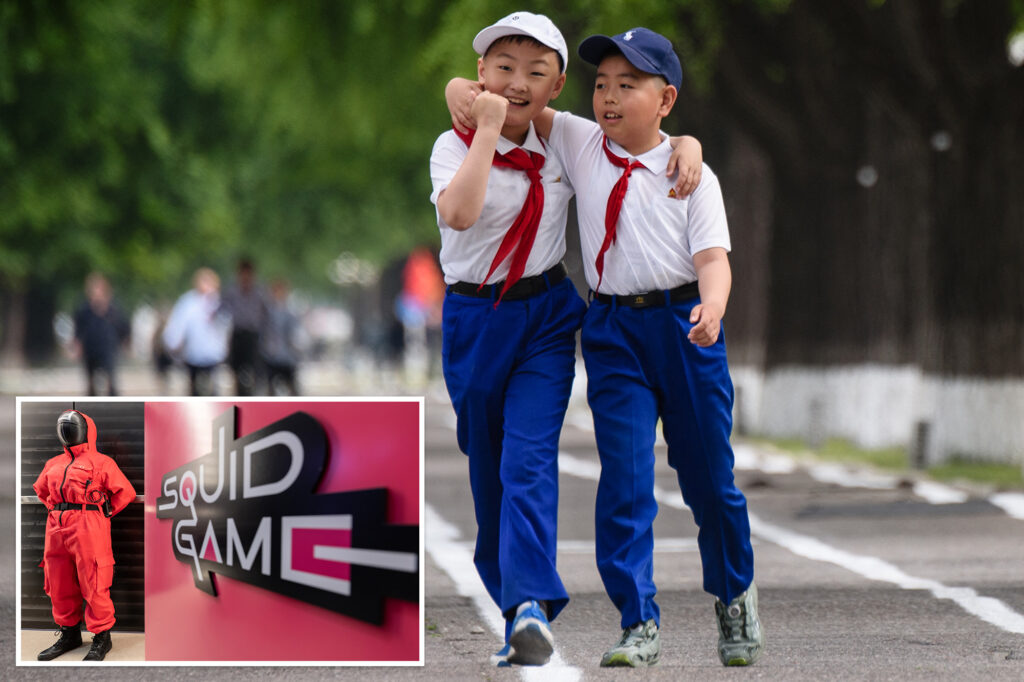
Reports have emerged indicating that North Korea has executed schoolchildren for watching foreign media, including the popular South Korean television series “Squid Game.” According to a recent report by Amnesty International, testimonies from defectors reveal a grim picture of human rights abuses tied to the regime’s stringent censorship laws.
The organization conducted 25 in-depth interviews with North Koreans who fled the country between 2012 and 2020, many of whom were teenagers at the time of their escape. These accounts detail harrowing incidents where young individuals, including middle school students, faced severe consequences such as public executions and imprisonment in labor camps for consuming media banned by the government.
In one particularly alarming account from Yanggang Province, an interviewee reported that individuals, including high school students, were executed for watching “Squid Game.” Separate investigations by Radio Free Asia corroborated these claims, documenting an execution for distributing the series in North Hamgyong Province in 2021. Amnesty International stated, “Taken together, these reports from different provinces suggest multiple executions related to the shows.”
The crackdown on foreign media has intensified under the leadership of Kim Jong Un. His regime implemented the 2020 Anti-Reactionary Thought and Culture Act, which categorizes South Korean media as “rotten ideology” that undermines the revolutionary spirit of the populace. The law prescribes harsh penalties, including five to fifteen years of forced labor for mere possession of South Korean dramas, films, or music, with even more severe repercussions—such as death—reserved for distribution or organizing group viewings.
Interviews with defectors reveal a troubling reality where punishment often hinges on financial means. Choi Suvin, a 39-year-old who escaped in 2019, shared, “People are caught for the same act, but punishment depends entirely on money.” He noted that individuals often resort to selling their homes to gather the necessary funds to avoid re-education camps. Another defector, Kim Joonsik, described how he managed to evade punishment for watching South Korean dramas three times due to his family’s connections, stating, “Usually when high school students are caught, if their family has money, they just get warnings.”
Conversely, others have not been as fortunate. Kim recounted that three of his sister’s high school friends received lengthy labor camp sentences in the late 2010s because their families could not afford bribes. Several escapees also described being forced to attend public executions as a form of “ideological education,” where they were made to witness the consequences of watching or distributing foreign media. Kim Eunju, who fled in 2019, recalled, “When we were 16, 17, in middle school, they took us to executions and showed us everything.”
Amnesty International highlighted the role of a specialized police unit known as the “109 Group,” which carries out warrantless home raids and street searches for foreign media. Fifteen interviewees described the operations of this unit, with one recalling officers stating, “We don’t want to punish you harshly, but we need to bribe our bosses to save our own lives.”
Despite the looming dangers, the report noted that foreign media continues to circulate within North Korea, often smuggled in from China on USB drives. One interviewee shared, “Workers watch it openly, party officials watch it proudly, security agents watch it secretly, and police watch it safely.” This indicates a widespread engagement with foreign media, even among those tasked with enforcing the regime’s strict censorship laws.
The brutality outlined by escapees aligns with previous documentation from South Korean officials, UN investigators, and US-funded broadcasters regarding the regime’s treatment of foreign media. In early 2024, footage surfaced showing two North Korean teenagers sentenced to hard labor for watching and distributing South Korean dramas. A UN human rights report from last year also warned of a growing reliance on public executions to instill fear, particularly for crimes related to foreign information.
Sarah Brooks, Amnesty International’s deputy regional director, emphasized the severity of the situation, stating, “These testimonies show how North Korea is enforcing dystopian laws that mean watching a South Korean TV show can cost you your life—unless you can afford to pay.” This stark reality underscores the oppressive measures used by the North Korean regime to maintain control over its populace and stifle any form of dissent or cultural exchange.