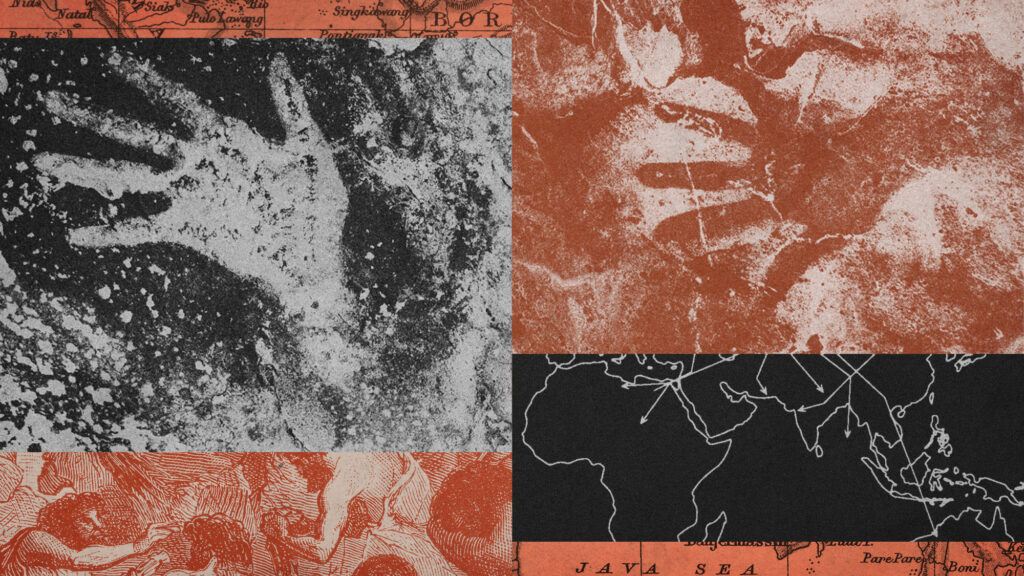
The discovery of rock art in caves on the Indonesian islands of Sulawesi and Borneo is shedding light on early human migration patterns. This artwork, believed to be over 67,000 years old, includes figurative cave paintings and stencils of human hands. Published in the journal Nature, the findings could provide significant insights into the migration of early humans out of Africa and across the region.
The art from Sulawesi dates back at least 67,800 years, predating previous discoveries by around 15,000 years, according to reports from Phys.org. This discovery is not entirely surprising, as Indonesia is known for hosting some of the world’s earliest cave drawings. While even older cave art has been found in South Africa, the Indonesian findings are crucial for understanding the cultural and technological capabilities of early humans.
Researchers believe that the artists created the stencils by blowing pigment over their hands placed against the cave walls, leaving an outline. Some fingertips appear to have been altered to look more pointed. This method reflects a level of sophistication in artistic expression that challenges earlier perceptions of human creativity.
Insights into Human Migration and Seafaring
Previous research indicates that humans left Africa 60,000 to 90,000 years ago, traveling through the Middle East and South Asia before reaching Australia. The newly discovered rock art may hold vital clues about this migration. Helen Farr, a maritime archaeologist at the University of Southampton, highlighted that this evidence supports the notion that early humans possessed seafaring technology, which enabled open-water crossings between Wallacea and Australia by about 65,000 years ago.
The significance of these findings extends beyond migration. Since sea levels were much lower at that time, land bridges formed between some neighboring islands. The art may provide insights into how humans navigated these landscapes and spread across the region. Farr noted the importance of preserving and dating this art, as it offers a glimpse into a range of activities often missing from archaeological records of that period.
Redefining Early Human Intelligence
The discovery prompts a reevaluation of early human intelligence and cultural development. Adam Brumm, a professor of archaeology at Griffith University and a co-author of the study, remarked that previous research focused on European cave art often led to the assumption that true artistic culture began there. The findings in Indonesia suggest that sophisticated artistic expression was present in other parts of the world long before Homo sapiens arrived.
Maxime Aubert, another co-author from Griffith University, suggested that these discoveries may not be isolated incidents but rather part of a deeper cultural tradition that has remained largely unseen until now. This perspective could shift the understanding of early human societies and their artistic endeavors.
Some researchers caution against drawing definitive conclusions. Paul Pettitt, a professor of palaeolithic archaeology at the University of Durham, urged for a careful consideration of the complexities surrounding these findings. He emphasized the importance of exploring other potential explanations for the cultural phenomena observed, rather than assuming a linear narrative of human success.
The revelations from Indonesia not only enhance the understanding of human migration but also challenge prevailing notions about the development of artistic culture. As ongoing research continues to uncover layers of early human history, the implications of these findings may reshape the narrative of our ancestors’ journey across the globe.