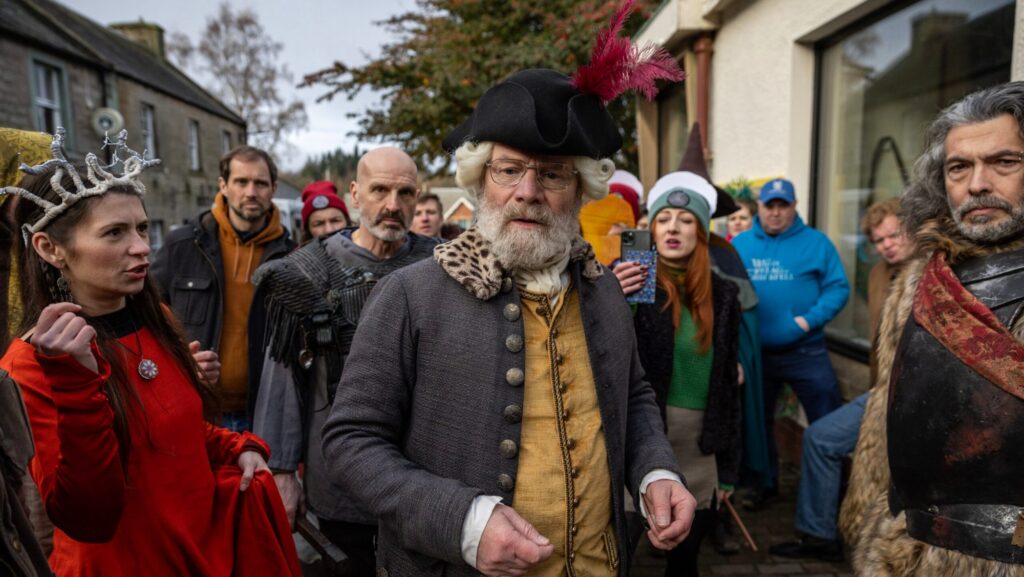
The film The Fall of Sir Douglas Weatherford, directed by Seán Dunn, makes its world premiere on January 30, 2024, at the International Film Festival Rotterdam. This feature film marks Dunn’s debut in the fiction genre after his work in short films like British by the Grace of God and Kingdom Come. The film tackles profound questions about the intersection of history and fiction, identity, and how narratives shape our understanding of self.
Set in the fictional Scottish village of Arberloch, the story revolves around Kenneth, played by Peter Mullan, who serves as a tour guide at a center dedicated to the legendary inventor and philosopher, Sir Douglas Weatherford. Kenneth dresses as Sir Douglas, claiming a distant familial connection to the historical figure. However, his world is turned upside down when a film crew arrives to shoot scenes for a popular fantasy series, The White Stag of Emberfell, drawing in enthusiastic fans clad in elaborate costumes. This influx of fantasy culture threatens to overshadow the local mythology surrounding Sir Douglas.
The film’s narrative is described as a “darkly comic study of aging, identity, and the fictions we cling to when everything around us shifts,” according to the festival. Mullan’s performance is complemented by a talented cast, including Gayle Rankin, Jakob Oftebro, Sid Sagar, and Lewis MacDougall.
The development of The Fall of Sir Douglas Weatherford involved collaboration with notable organizations such as BBC Film and financing from the BFI Film Fund, BBC Scotland, and Screen Scotland. The producers, Alex Polunin, Scott Macaulay, and Jennifer Monks, have ensured a high-quality production, with cinematography by David Gallego and music by Gazelle Twin.
Dunn’s inspiration for the film came from a personal experience during a visit to a historic graveyard in Edinburgh with his wife, who is from Dubai. They encountered tourists performing an incantation at the grave of Thomas Riddle, a name that resonated with Harry Potter fans as the real identity of Voldemort. This striking juxtaposition of reality and fantasy sparked Dunn’s curiosity about how historical figures can be overshadowed by fictional narratives. He noted, “This was a real guy. And I thought it was interesting that this guy had a history that has basically been erased and replaced by this fantasy.”
The director elaborated on Scotland’s complex identity, often viewed through its historical relationship with England. Dunn reflected on the notion of Scottish pride and its connection to egalitarian values, saying, “We see ourselves as being conquered culturally, but our national identity is tied up in egalitarianism.” He highlights the irony in how Scotland’s historical figures, once perceived as heroes, can be re-evaluated in contemporary contexts.
In discussing Mullan’s involvement, Dunn expressed his appreciation for the actor’s talent and experience. Mullan, known for his role as King Durin III in the series The Lord of the Rings: The Rings of Power, brought a wealth of improvisational skills to the project. “He has ideas that are always better than what I’d written,” Dunn remarked, emphasizing Mullan’s deep understanding of the fantasy genre.
While Dunn acknowledges the cultural impact of franchises like Game of Thrones and The Lord of the Rings, he admits, “I’m not a big fan” but finds the sociological aspects of these phenomena intriguing. The film aims to explore the often-generic nature of fantasy narratives while remaining respectful of the genre’s dedicated followers.
As the story of Kenneth unfolds, viewers witness his struggle with identity as external forces challenge his long-held beliefs. Dunn pointed out the universal experience of confronting change, stating, “Just the fact of them being challenged a little bit throws him into this existential crisis. He’s lost.” This theme resonates in a world experiencing rapid transformation, where many grapple with shifting perspectives and identities.
Looking ahead, Dunn shared that he has been actively writing during the film’s editing process. He mentioned two new projects, one set in the late 19th century exploring themes of identity and guilt, and another addressing the Y2K phenomenon involving conspiracy theories. Dunn’s commitment to storytelling reflects his desire to creatively engage with the complexities of human experience.
Overall, The Fall of Sir Douglas Weatherford stands as a thought-provoking exploration of the boundaries between history and imagination, inviting audiences to reflect on the narratives that shape their lives.