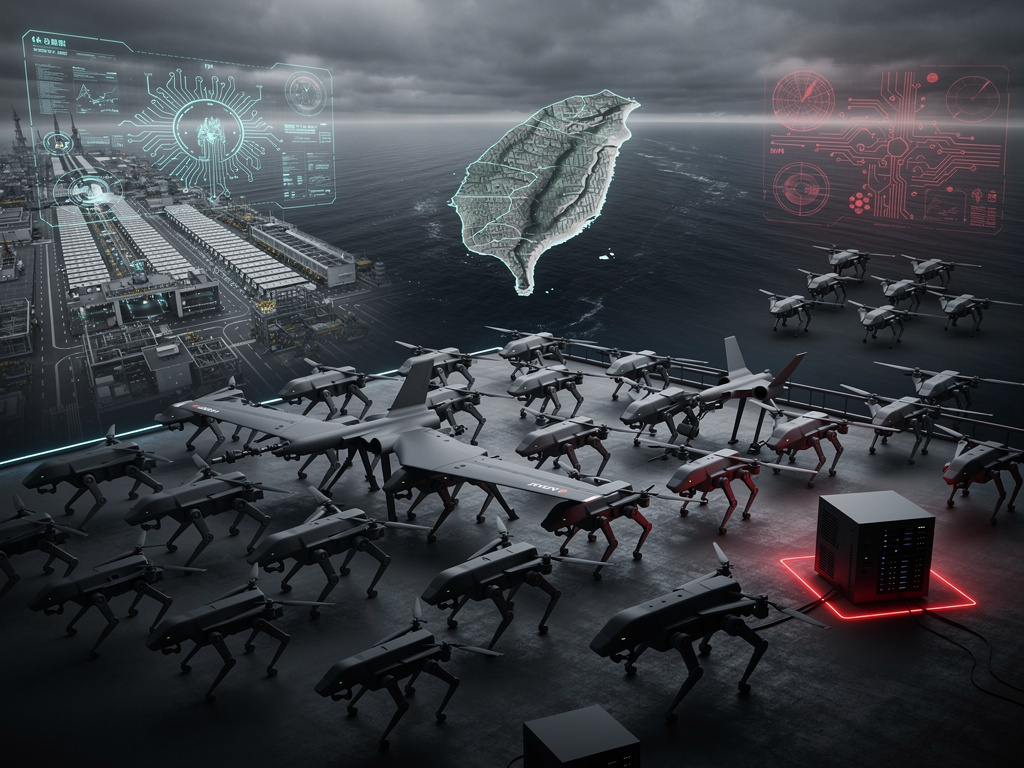
BREAKING: In a groundbreaking development, engineers at Beihang University, a military-affiliated institution, have successfully trained drones to mimic hawks and doves in a stunning simulation of drone swarm combat. This innovation aligns with China’s escalating focus on integrating advanced artificial intelligence into autonomous weaponry, marking a significant leap in military capabilities.
In a recent five-on-five test, hawk-trained defensive drones obliterated all opponents in just 5.3 seconds. This remarkable achievement earned a patent in April 2024, showcasing the Chinese military’s commitment to harnessing nature-inspired AI in warfare, according to reports from The Wall Street Journal.
This urgent shift in military strategy comes as the People’s Liberation Army (PLA) intensifies efforts to develop swarm tactics, deploying thousands of drones and robot dogs with minimal human oversight. As of October 2024, military theorists in China emphasized that the era of AI-driven warfare is upon us, with unmanned systems poised to dominate the battlefield.
Chinese factories currently produce over 1 million drones annually, dwarfing the U.S. output of tens of thousands at significantly higher costs. State media recently showcased the Swarm 1 truck system, capable of launching 48 fixed-wing drones, scalable to 200, for various military operations including reconnaissance and strikes.
The newly developed Jiutian mothership drone, which successfully completed its maiden flight in December 2024, is designed to deploy smaller drone swarms, further enhancing China’s combat capabilities. In September 2024, the PLA unveiled weaponized robot dogs, dubbed ‘robot wolves’, aiming to merge these with aerial swarms for collaborative combat operations.
Experts are alarmed at the speed of these advancements. Sunny Cheung from the Jamestown Foundation noted, “There’s a growing consensus that autonomous systems may outperform human fighters in tactical scenarios.” This is particularly crucial given that PLA soldiers have not engaged in large-scale combat since the 1970s.
The ongoing conflict in Ukraine, where enemy forces have employed jamming tactics against drones, has further intensified Beijing’s focus on developing resilient autonomous systems. Procurement platforms reveal ambitious plans, including a 2024 tender for a mobile cognitive warfare system featuring AI deepfakes and robot dogs for reconnaissance missions.
Since 2022, Chinese entities have filed over 930 swarm intelligence patents, vastly outpacing the U.S., which has seen only 60 such filings. Beihang professor Duan Haibin highlighted the importance of improving drone perception, presenting simulations inspired by eagles and fruit flies at a Beijing conference.
By 2025, the PLA plans to integrate DeepSeek AI into several weapons systems, enhancing their operational effectiveness against threats. This includes autonomous vehicles capable of speeds up to 50 km/h and drone swarms targeting agile threats. Recent tenders show a strong preference for using AI-driven robot dogs for scouting and hazard clearance missions.
On January 23, 2026, the PLA’s National University of Defense Technology demonstrated a soldier managing over 200 autonomous drones in just 99 seconds for urban combat scenarios, underscoring the shift towards “effect-based control” that is resistant to jamming.
As the U.S. struggles to keep pace, developing its own $35,000 kamikaze drones, experts warn that American forces could lag behind. Justin Bradley from North Carolina State University cautioned about inadequate perception capabilities in U.S. drones, which rely on vulnerable radio communications.
The implications of these advancements are significant. In potential conflicts with Taiwan, Chinese drone swarms could operate from distances of 50 miles, targeting enemy jets or defenses, raising alarms about the future of warfare in the region.
While global calls for limits on autonomous weapons systems grow, China is racing to redefine combat with swarms of intelligent machines. The rapid advancements in AI and drone technology raise critical questions about safety, oversight, and the potential for unintended consequences in warfare.
As military leaders and analysts worldwide watch closely, the race for dominance in autonomous warfare technology intensifies, with China poised to lead the charge into a new era of combat.