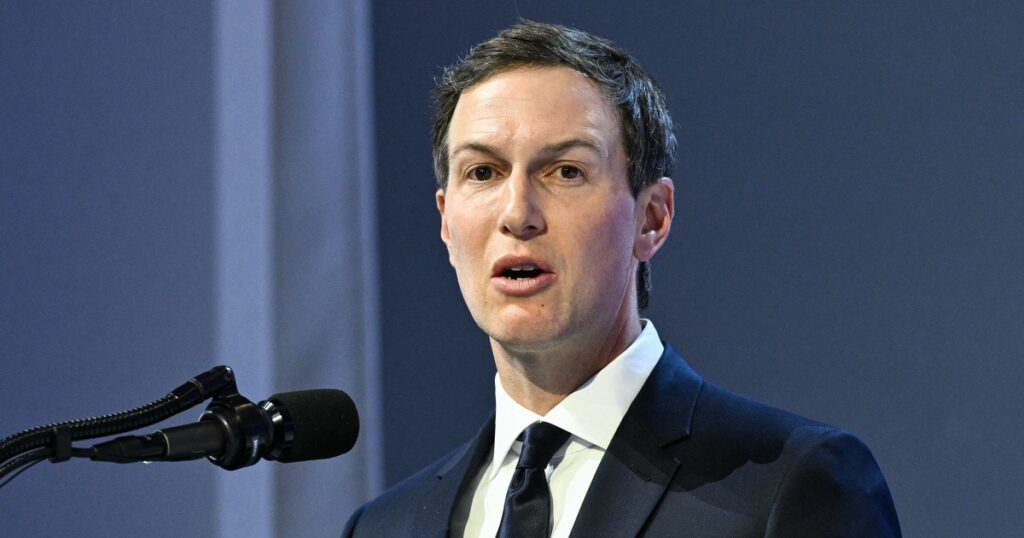
Jared Kushner, son-in-law of former President Donald Trump, recently revealed an ambitious plan for a revitalized Gaza during the World Economic Forum in Davos. His vision, dubbed “New Gaza,” features modern high-rise buildings and bustling tourist areas, starkly contrasting the current reality of a region devastated by years of conflict. Kushner asserted that the initial stages of reconstruction could begin within two to three years, despite the ongoing humanitarian crisis affecting the territory.
Contrasting Realities in Gaza
Presenting to world leaders, Kushner highlighted efforts already underway, stating, “We’ve already started removing the rubble and doing some of the demolition.” His presentation included slides showcasing futuristic architectural concepts and a map detailing zones for tourism, residential areas, and advanced manufacturing. Yet, on the ground in Gaza, the situation remains dire. Since the October 7, 2023 terrorist attacks led by Hamas, which resulted in approximately 1,200 deaths, the area has faced severe restrictions on construction materials.
According to the Palestinian Health Ministry, over 71,000 Palestinians have lost their lives due to the ongoing violence. Many of Gaza’s 2 million residents have been displaced, living in precarious conditions exposed to disease and harsh weather. Israeli military operations continue, with airstrikes targeting what the government claims are Hamas installations, complicating any potential rebuilding efforts.
Local residents expressed skepticism about Kushner’s plans. Ghassan Al-Tanani, who recently lost a brother in an Israeli airstrike, questioned the reality of a “World Peace Council” in Gaza, stating, “We’ve been looking for it and we can’t find it.” Another resident, Ghassan Qudeeh, voiced concerns that any future initiatives could lead to increased Israeli control over the region.
Challenges and Skepticism Surrounding the Plan
Despite the optimism expressed by Kushner, local and international skepticism looms. He insisted, “There is no Plan B” beyond his vision for Gaza, aiming for the region to become a hub of industry and opportunity. Kushner projected that Gaza could achieve a gross domestic product exceeding $10 billion by 2035. However, the United Nations Office for Project Services estimates over 60 million tons of rubble must be cleared before any significant rebuilding can begin, a process that could take years.
White House Deputy Press Secretary Anna Kelly dismissed the U.N.’s estimates as “laughable,” criticizing their credibility. The potential for constructing new infrastructure such as a port and airport raises questions about security concerns that Israel may have, particularly regarding visibility of military bases near its borders. Nomi Bar-Yaacov, an associate fellow at the Geneva Centre for Security Policy, noted that Israel would likely reject any high-rise developments that compromise its security.
Moreover, Israeli officials have not publicly commented on Kushner’s proposals, leaving uncertainty surrounding the collaboration required for such initiatives. Finance Minister Bezalel Smotrich has advocated for a “military government” in Gaza, emphasizing his support for Israeli settlement in the area, which further complicates the situation.
Kushner’s Board of Peace, which lacks Palestinian representation, has appointed Ali Shaath, a former Palestinian planning minister, to oversee a technocratic body for managing daily affairs in Gaza. This absence of local voices in critical decision-making processes raises further concerns about the feasibility and acceptance of the proposed plans.
Kushner’s vision for a future Gaza aims to inspire hope, but the stark realities on the ground and the complex geopolitical landscape present significant obstacles. The path to rebuilding will require not only significant resources but also a fundamental shift in the current dynamics of power and control in the region.